I start a B2B influencer contract by defining what gets delivered, when payment is due, and how the content can be used. For example, if payment depends on approval, I set a written review deadline - such as 5 business days - so payment cannot stall indefinitely.
Before work starts, I put these terms in writing:
- Scope: Deliverables, channels, deadlines, revisions, and reporting rules.
- Payment: Fees, invoice deadlines, expenses, taxes, and dispute steps.
- Compliance: Sponsor disclosures, claim checks, approvals, and monitoring.
- Rights: Content ownership and separate permissions for reposting, ads, and sales materials.
- Risk and exit: Confidentiality, data protection, exclusivity, liability, cancellation, and disputes.
My rule: <u>pay for defined work, not promised revenue</u>. I also have a qualified U.S. attorney review the agreement before signing. Clear terms help both sides know what they owe - and what happens if plans change.
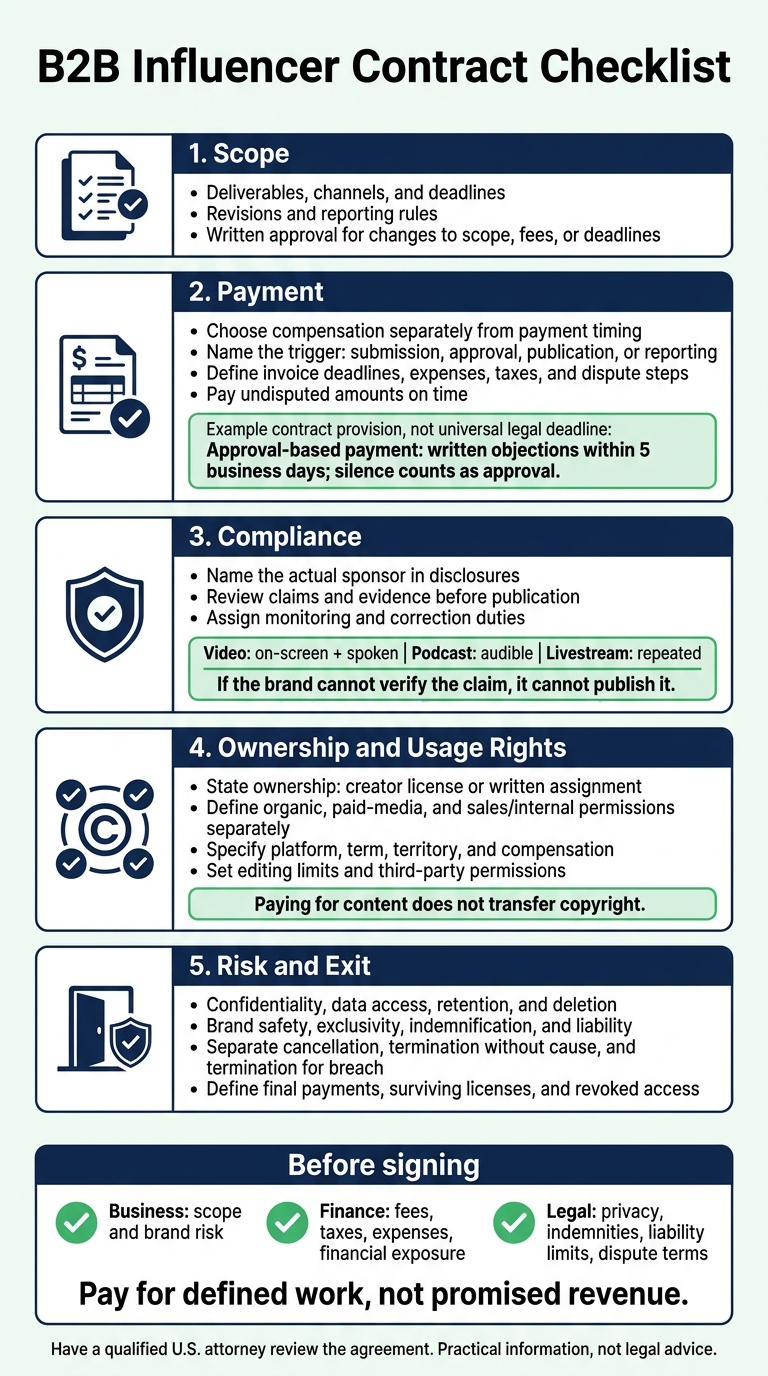
B2B Influencer Contract Checklist
2. Set Compensation and Payment Terms
Choose a Compensation Model
Separate compensation from payment timing. Choose a model based on campaign economics, production effort, budget, and what you can measure.
| Model | Budget predictability | Administrative complexity | Measurement risk |
|---|---|---|---|
| Fixed per-deliverable fee | High | Low to moderate | Low |
| Milestone payments | High once milestones are defined | Moderate | Moderate if acceptance is subjective |
| Performance-based pay | Low to moderate | High | High; depends on attribution and verified results |
| Hybrid base fee plus incentives | Moderate to high | High | Moderate to high |
Set a fee for each deliverable. State whether it covers production, revisions, posting, reporting, licensing, and exclusivity.
Define affiliate commissions separately, including the tracking method, rate, attribution window, refund treatment, and payout schedule. For bonuses, set objective triggers, rules for combining bonuses, and caps. For noncash benefits, document their value, delivery date, restrictions, and whether they supplement cash payments. Noncash benefits may also require endorsement disclosures.[2]
Tie each fee to a clear payment event.
Define Payment Triggers and Exceptions
Name the payment trigger: submission, approval, publication, or reporting. If payment depends on approval, require written objections within 5 business days and treat silence as approval. Make clear that client-side publication delays cannot defer payment. Specify payment in U.S. dollars, the payment method, and an invoice payment deadline that follows applicable law.
Require invoices to include the legal payee name, address, invoice number, campaign or milestone, taxes, approved expenses, payment instructions, and any purchase-order number. Expenses need written preapproval, a reimbursement cap, and a receipt deadline. Exclude personal upgrades and unapproved purchases.
Example terms: Payment is due within 30 days after receipt of a valid invoice; reimbursements are capped at $500, with receipts due within 30 days.
State whether fees include applicable sales tax or similar taxes. Collect Form W-9 from U.S.-based influencers or contractors. Assign income and self-employment tax obligations to the influencer without removing the client’s legally required reporting and withholding duties.[1][4]
For late, incomplete, rejected, or noncompliant work, require written reasons and a correction window before applying proportionate fee reductions. Tie reductions to the affected work, not the whole campaign. Exclude delays caused by client feedback or changed instructions.
Require written invoice disputes within 10 business days, name an escalation contact, and pay undisputed amounts on time. Check applicable state and local freelance-payment rules before signing. Governing law does not override mandatory payment protections.
sbb-itb-01010c0
How to Create an Influencer Marketing Agreement for Brands
3. Set Disclosure and Compliance Rules
With payment terms set, put disclosure and review rules in writing before publication.
Make FTC compliance a contract duty, not a suggestion. The rules should keep the campaign compliant and ready to publish across channels. Define material connections broadly: payment, free products, affiliate commissions, gifts, travel, access, equity, employment, consulting, and close personal ties.[6][8][3]
Require the brand to provide disclosure instructions, approve wording, train the influencer, check samples of published content, and correct problems promptly.[3][11] Write these duties by content type and enforce them before anything goes live.
Define Disclosures by Content Format
Attach a disclosure schedule that requires language naming the actual sponsor:
Ad, Sponsored by [brand], or Paid partnership with [brand].
Place disclosures where the audience will see them first - before text gets cut off, never behind links, in comments, or buried in hashtags. Avoid vague labels such as partner or collab. Disclose affiliate compensation near the relevant endorsement or link.[9][10]
Require on-screen and spoken disclosures in videos, audible disclosures in podcasts, and repeated disclosures in livestreams.[6][7][8][3] Require the platform’s branded-content tool where available, but do not assume its label alone is enough.[12]
Assign Claims Review and Compliance Monitoring
Require honest endorsements based on genuine, current experience. Prohibit unsupported claims about performance, savings, security, or comparisons. Name the brand reviewer responsible for checking the evidence behind each claim.
Require review of drafts, scripts, graphics, captions, and supporting evidence before publication. Keep approved versions, disclosure screenshots, URLs, publication dates, and approval records. If the brand cannot verify the claim, it cannot publish it. Send regulated or technically complex claims for legal or subject-matter review.
Name the person responsible for monitoring published content. Set the check frequency, reporting process, and correction deadlines. For example, require a missing disclosure to be corrected within 24 hours of notice. Require immediate action on materially false or unsupported claims, including takedown when needed, and confirm that corrections were made. Allow suspension or termination for repeated violations.
Before signing, check the current FTC Endorsement Guides and any industry-specific rules. For longer campaigns, include a process for updating requirements.[5][8]
4. Define Content Ownership and Usage Rights
Once approval and disclosure rules are set, spell out who owns the content and how the brand can reuse it.
Paying for content does not transfer copyright. The agreement should state whether the creator keeps ownership and grants a license or transfers ownership through a written assignment.
Use a license when the brand needs limited rights. Use an assignment when it needs ownership. Don’t rely on work made for hire alone: it requires both a written agreement and qualifying work.
Specify Organic, Sales, and Paid-Media Rights
Include a rights matrix before signing. Separate organic use, paid media, and sales/internal use. Permission to repost is not permission to use content in ads or sales materials. Define the platform, term, territory, and compensation for each category.
| Use category | Example uses | Rights to define | Compensation |
|---|---|---|---|
| Organic | Reposting on brand channels | Platform, term, territory | Per contract |
| Paid media | Ads and boosting | Platform, term, territory | Per contract |
| Sales/internal | Pitch decks or case studies | Platform, distribution scope, term, territory | Per contract |
Then set limits on edits and the use of third-party content.
Define Editing and Third-Party Permissions
Distinguish minor edits from larger changes. State whether resizing or cropping is allowed, and include any needed waiver of moral rights, to the extent permitted by law. List third-party materials separately, including logos, images, music, and quotes.
5. Set Risk and Exit Terms
Once rights and usage are set, define the rules for confidentiality, liability, and ending the agreement.
Assign Confidentiality, Data, and Liability Duties
Define what counts as confidential information, who can access it, exceptions for publicly available information, required safeguards, and return or deletion duties. Set a confidentiality term. Trade-secret duties should last as long as the information remains a trade secret.
Do not assume lead data can be freely shared. Specify permitted uses, access, retention, deletion deadlines, applicable privacy laws, and any required data-processing addendum. Require least-privilege access, multifactor authentication, cooperation on incident response, and notification within 24 hours after discovery, subject to applicable law.
Set objective brand-safety rules for illegal conduct, harassment, artificial engagement, and platform violations. Require conflict disclosures and warranties that each party has authority to sign, will act lawfully, and will use original or properly licensed work. Limit exclusivity by named competitors, product category, territory, channel, and duration, with agreed exceptions.
Tie indemnification to risks each party controls, including brand-supplied claims. Define who controls the defense and approves settlements. State the liability cap, excluded damages, and negotiated carve-outs for matters such as fraud, data breaches, and IP claims.
Define Cancellation, Termination, and Dispute Rules
The contract should explain when work stops and what each side still owes if obligations aren't met.
Treat cancellation before work starts, termination without cause, and termination for breach as separate situations. Specify written notice and a cure period, such as 10 business days. Allow immediate suspension or termination for serious security breaches, fraud, or illegal conduct, and set correction and takedown deadlines.
Make payment duties clear when the agreement ends. Explain who pays for accepted work, approved work completed to date, expenses, and cancellation fees. Address prepaid amounts, unused deliverables, surviving licenses, paused paid media, and revoked access.
For platform outages and other events outside either party's control, require notice, mitigation, rescheduling, and a final cancellation date. Keep obligations in place when they can still be performed, including payment for accepted work and confidentiality.
Identify governing law, venue or arbitration forum, escalation steps, formal-notice methods, and receipt rules. Recognize electronic signatures. Require both parties' written approval for changes to scope, fees, deadlines, exclusivity, or usage. State which document controls if the agreement and statement of work conflict.
Conclusion: Review Before Signing
Before signing, check deliverables, payment, disclosures, usage rights, data protections, liability, exit terms, exclusivity, governing law, and venue. Get business approval for scope and brand risk; finance approval for fees, taxes, expenses, and financial exposure; and legal approval for privacy, indemnities, liability limits, and dispute terms.
Have a qualified U.S. attorney review the agreement, especially when it involves regulated industries, customer data, international parties, or extensive paid-media rights. This article provides practical information, not legal advice.
FAQs
Can I use a contract template for B2B influencers?
Yes, but don’t rely on generic or incomplete agreements. Get expert advice to make sure your contract is thorough, enforceable, and meets industry-specific requirements.
Use plain language to spell out deliverables, review steps, exclusivity windows, timelines, and payment terms. Include clauses covering compliance, legal protection, dispute resolution, and intellectual property so expectations are clear and your interests are protected.
How should I price extended content usage rights?
Price each usage right separately instead of bundling them into one fee. This makes it easier to adjust the price if certain rights can’t be delivered.
Define the usage scope in your contract, including how long the rights last, which media channels are permitted, and whether usage is exclusive or non-exclusive. Specify who owns the content and any required trademark attribution.
What changes if my influencer is outside the U.S.?
When working with an influencer outside the U.S., check the regulations and geographic restrictions that apply. Define where exclusivity clauses apply to prevent conflicts. Along with U.S. Federal Trade Commission requirements, international collaborations may need to meet local legal standards and consumer protection laws.
Spell out the remedies for contract breaches, and consult legal experts about cross-border requirements. The B2B Ecosystem offers resources and support for international B2B collaborations.