Most co-branded media campaigns fail for one reason: the two brands never agree on the goal, the work, or the scorecard.
If I were building one today, I’d keep it simple. I’d start with one business goal, pick a partner with the same buyer, set clear ownership, and track pipeline, CPL, SQL rate, and revenue from day one. That matters because co-branded campaigns can drive 53% higher engagement, and buyers now do much of their research alone - 75% prefer self-service and 57% buy without talking to sales.
Here’s the short version:
- Set one goal first - pipeline, brand reach, ACV, or sales-cycle length
- Pick a partner with audience overlap and a product that fits beside yours
- Agree on scope early - budget, assets, timelines, approvals, lead access, and usage rights
- Build one shared message and keep brand rules clear before design starts
- Launch with tracking in place - UTMs, lead tags, partner links, and one source of truth
- Review performance on a set cadence - weekly, monthly, and quarterly
- Judge the campaign by revenue impact, not by clicks alone
What this comes down to is simple: co-branding is not a logo swap. It’s a joint media program with shared work, shared measurement, and a clear rule for whether to scale, fix, or stop.
If I had to sum up the article in one line, it would be this: plan the partnership before you promote it.
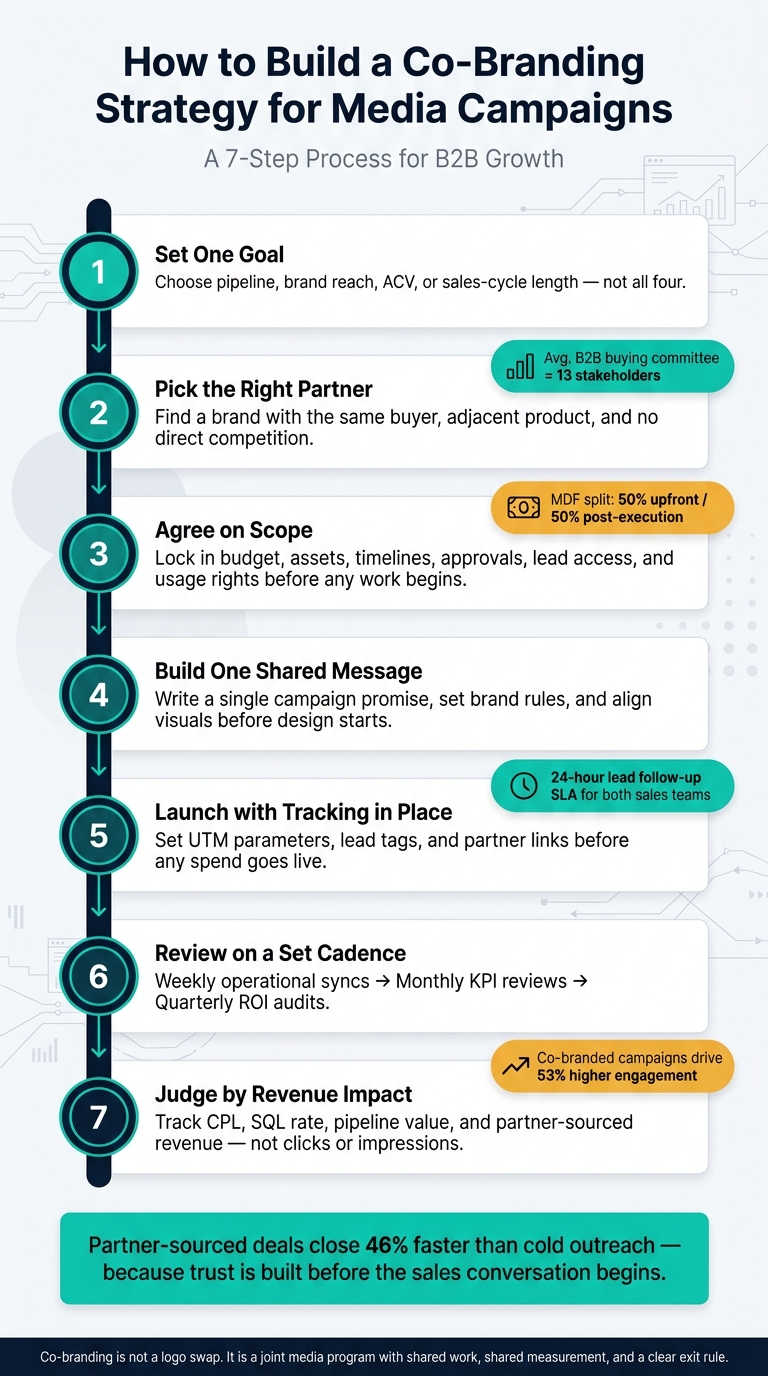
Co-Branding Campaign Strategy: 7-Step Framework for B2B Media Campaigns
What Is Co Branding? (5 Powerful Strategy Examples)
sbb-itb-01010c0
Define Campaign Goals and Success Metrics
Start by defining the outcome the campaign needs to move.
Set the Primary Business Goal and Target Audience
In co-branded campaigns, that usually means one of a few things: driving pipeline, building brand credibility, increasing ACV, or shortening sales cycles [4]. If you try to chase every goal at the same time, the message gets fuzzy and the budget gets spread too thin.
Once the goal is set, agree on a shared ideal customer profile (ICP). Then look for partners that serve the same audience but solve adjacent problems [4]. That matters in B2B because you are almost never selling to one person. The average buying committee includes 13 stakeholders [4].
Map out which partner carries the most weight with each stakeholder group. Maybe one brand has stronger trust with practitioners, while the other lands better with budget owners or executives. Use that to shape the joint story. It also makes partner selection and format choice a lot easier.
Choose the Campaign Format and Channel Mix
Pick the format that best fits the goal. Common co-branding formats include webinars, reports, and case studies. If attendance is the target, webinars can be a strong bet - co-branded webinars have produced a 53% higher attendance rate than solo campaigns [4].
For distribution, keep the mix tight. A focused setup often works best:
- Email nurture flows
- Joint social media amplification on LinkedIn or X
- Co-funded paid media
Pair a high-trust asset, like a webinar or report, with channels that help extend reach and support conversion. Once the format and channels are locked in, set the measurement rules before launch. Not after.
Define KPIs, Attribution Rules, and Reporting Cadence
Measure business impact, not just activity. Track metrics like CPL, SQL rate, pipeline value, partner-sourced revenue, and partner-influenced revenue. In plain terms, partner-sourced revenue is tied to deals directly attributed to the partner, while partner-influenced revenue covers deals shaped by campaign engagement. Impressions and downloads can help with optimization, but they should not lead the review meeting.
Set up UTM parameters, unique partner tracking links, and lead tags before anything goes live. Also agree on one system of record [5]. If two teams are pulling numbers from two places, you'll spend more time arguing about data than using it.
For reporting cadence, a three-tier structure keeps things under control [5]:
- Weekly operational check-ins for lead flow and technical QA
- Monthly performance reviews for SQL conversion and CPL
- Quarterly audits to reconcile spend and assess overall ROI
With goals and measurement in place, the next step is finding a partner that can support them.
How to Select a Co-Branding Partner
Use the goal and ICP from the previous step to narrow your list of partner options. This is the point where most co-branding programs either work or fall apart. Pick a partner that reaches the same buyers, fills a gap on your side, and can actually get the work done.
Check Brand Fit, Audience Overlap, and Credibility
Start with adjacent brands. In plain English, that means brands whose products or services fit alongside yours without going head-to-head. That kind of fit makes the partnership feel natural to buyers instead of awkward or bolted on.
Then look at brand fit and audience overlap. If both companies speak to the same kind of buyer, the partnership has a much better shot. If the messaging, tone, or market position feels off, buyers will notice.
Credibility matters too. Review past campaigns, public messaging, and how the brand shows up in market. You want to confirm that the partnership will look consistent and trustworthy to the shared audience.
Confirm Complementary Capabilities and Execution Readiness
A good partner should bring something you don't. That could be reach, content, subject matter depth, budget, distribution, or follow-up capacity. The best pairings are simple: each side fills a clear gap for the other.
Also, assign one clear owner for partner enablement. Don't treat it like a once-a-quarter admin task. Someone needs to own the process, keep things moving, and remove blockers.
Before you commit, run one pilot - for example, a webinar or a co-authored guide. This gives you a clean way to test the workflow across writing, approvals, distribution, and follow-up. A pilot will show execution gaps faster than any intake form ever will.
If the pilot works, lock the scope and responsibilities before you scale.
Once the partner is validated, define the value exchange, scope, and ownership.
Align the Value Exchange and Campaign Scope
Once the pilot shows the workflow works, lock in the terms for the full campaign. At this point, the partner is no longer just "interesting" - they're approved. Now the job is to turn that interest into a written scope and an operating agreement. Before any work begins, both sides need a clear record of contributions, upside, and limits.
Define Contributions, Benefits, and Budget Split
Every co-branded campaign is an exchange. One partner may bring audience access and media inventory. The other may bring subject-matter expertise, creative support, or paid media dollars through Market Development Funds (MDF).
Spell out what each side is putting in and what each side expects back. That usually includes lead access, brand visibility, pipeline influence, content reuse rights, and shared credibility. If one partner is funding paid media through MDF, handle it like a planned investment - not a loose budget line with no follow-through. A simple way to do that is a two-stage MDF release: 50% upfront against the plan, 50% after execution and lead reporting [1][7].
Set Responsibilities, Timelines, and Usage Rights
Write down every owner before launch. Be specific about who handles copy, design, landing pages, approvals, and trafficking. Also set up a deal registration log that tracks the account, persona, owner, and next step. That avoids the usual mess later when both teams think they should get credit for the same lead.
Document these terms before launch:
| Term to Document | What to Include |
|---|---|
| Commercial rules | MDF eligibility, lead sharing, territory exclusivity, discounting policy |
| Creative rules | Co-branding rules, asset usage guide, legal/compliance checklist |
| Responsibilities | Named owners for copy, design, landing pages, approvals, and trafficking |
| Timelines | Launch date, approval deadlines, review deadlines |
| Usage rights | Content reuse permissions, data-sharing consent, brand safety rules |
Set a 24-hour lead follow-up SLA for both sales teams [6]. Include data-sharing consent for leads collected through shared landing pages or gated content. These are the guardrails that keep the campaign clean once it goes live.
With scope, ownership, and rights locked, move into shared messaging and asset production.
Build the Campaign Structure and Creative Assets
Turn the agreement into messages, visuals, and assets both teams can review, approve, and launch. The goal is simple: use the scope to build assets that are ready to go live.
Create the Shared Message and Visual Rules
Start with one campaign promise - a single sentence that explains what the partnership delivers that neither brand could offer on its own. Then build one joint narrative around that idea, so both brands come out stronger. Every asset should support that promise. That includes proof points, CTAs, and landing page copy.
Once the message is locked, set the brand rules before anyone opens a design file. Define logo order, placement, tone of voice, and any required disclaimers. This helps stop one partner's brand from taking over the campaign halfway through.
It also helps to create a brand-trust checklist. Keep it tight and practical. Review:
- Speaker quality
- Content claims review
- Audience overlap analysis
- Brand-safety issues
Run every asset through that checklist before it moves to approval.
Map Channels, Assets, and Approval Ownership
Map each channel to one job, one owner, and one KPI. Tie every channel to a buyer-journey stage - reach, education, conversion, or proof - so the plan stays connected to campaign goals. Then schedule the deliverables in plain terms: email drop date, social post cadence, webinar dates, and landing page timing.
Use the table to assign one role, one owner, and one KPI per channel.
| Channel | Role | Asset Owner | Approval Owner | KPI Focus |
|---|---|---|---|---|
| Nurture flows & direct outreach | Marketing Lead (Channel) | Operations Manager | Lead Volume / CTR | |
| Social Media | Joint amplification & engagement | Creative Director | Partner Success Manager | Engagement Rate |
| Paid Media | Co-funded demand generation | Campaign Manager | Finance (MDF) | CPL / Pipeline Value |
| Webinars | Subject matter expertise sharing | Subject Matter Expert | Marketing Lead | Attendee-to-MQL rate |
| Landing Pages | Conversion & lead capture | Web/Ops Team | Legal/Compliance | Conversion Rate |
| Case Studies | Demonstrating combined value | Content Lead | Partner Stakeholder | Influenced Revenue |
Before launch, validate UTM tags and tracking on every landing page. After tracking is verified, launch in a controlled sequence so early results can guide optimization.
Launch, Track, and Optimize Performance
Once assets are mapped, approved, and tracking is checked, the job changes. Now it's about keeping the campaign clean in-market and spotting issues early - before small mistakes turn into expensive ones.
Set Up Tracking, QA, and Rollout Timing
After scope and assets are approved, the launch should test the workflow in a live setting. The first rollout isn't just about going live. It's where you confirm that tracking, routing, and handoffs work the way they should.
Start small: one asset, one channel. That makes it easier to spot problems fast without muddying the data. Use the approved campaign scope and tracking rules as your launch checklist.
Set up attribution tracking before any spend goes live. Before budget is deployed, confirm that:
- UTM parameters are unique for each shared asset and partner
- Lead tags map correctly in the CRM
- Partner-specific landing pages are in place
Review Results, Optimize Spend, and Document Lessons
Use the review cadence below to manage performance and spend. The point is simple: turn performance data into spend decisions.
| Review Type | Frequency | Focus |
|---|---|---|
| Operational Sync | Weekly | UTM validation, early lead counts, and tracking fixes [5] |
| Performance Review | Monthly | KPI tracking (SQLs, CPL) and pipeline impact [5][2] |
| Business Review | Quarterly | MDF spend audits, ROI analysis, and extension decisions [5] |
Your shared dashboard should pull data from your CRM and ad platforms. Track partner-sourced leads, cost per lead (CPL), SQL conversion rate, and pipeline value - not impressions alone. [5]
If a channel is underperforming, don't shut it off right away. First, shift MDF and paid media toward the best-performing channel, adjust creative, or tighten targeting. [5] If results still fall short, figure out why before scaling down. Compare performance to forecast and isolate the issue: creative, offer, traffic source, or timing. Then decide whether to extend, revise, or end the partnership. [8]
At the close of the campaign, document which channel, asset, and partner input drove the result. That record becomes the baseline for every co-branded campaign that follows. [3]
Conclusion
A co-branding campaign is only as strong as the choices made before launch. Start with one clear goal. Pick a partner that fits. Define who owns what. Set shared creative rules. Then use one measurement framework tied to pipeline influence and partner-sourced revenue - not vanity metrics. After launch, the review tells you what happens next.
The last step is the review. Look at results by campaign, creative, and partner tier. Then make the call: renew, scale back, or exit. Co-branding is a performance partnership, not a one-time promotion. That lens should shape every renewal, scale-back, or exit decision. If a partner keeps missing commitments or shows weak engagement, cut spend or end the partnership.
Partner-sourced deals close 46% faster than cold outreach because trust is already established before the sales conversation begins. [4] And that changes the math. When the partnership works, the gains stack up over time. When it doesn't, the review gives both sides a clear basis for action.
FAQs
How do we choose the right co-branding partner?
Use a weighted rubric to score brand alignment, audience match, and execution capacity. That gives you a clearer way to compare options instead of going with gut feel alone.
Pick a partner with shared, measurable goals and a clear win-win plan that goes beyond simple logo placement. If the only idea is “we’ll put both brands on it,” that’s usually too thin.
You also want to check for a good culture fit, complementary strengths, and clear rules around roles, decisions, and IP. Spell that out early so no one is guessing later.
Start with one campaign first. It’s the best way to test workflow, communication, and how well the two teams actually work together before you scale.
What metrics matter most in a co-branded media campaign?
Focus on metrics that map to business results, not surface-level numbers like impressions or downloads.
Put the most weight on partner-derived pipeline, partner-attributed opportunities, revenue growth from sponsored segments, customer engagement, integration usage among shared customers, acquisition costs, and brand impact measured through sentiment and recall.
Then use click-through rates and interaction levels to fine-tune performance. Those numbers won’t tell the whole story on their own, but they can show what’s working, what’s falling flat, and where to adjust.
How can we prevent ownership and lead-sharing conflicts?
Set clear governance at the data layer. Use partner relationship management portals or CRM mappings to enforce standard lead-routing rules and deduplication.
Track the full deal chain, not just a single claimant, so credit and compensation match who actually contributed. Put these rules in a signed Memorandum of Understanding, including privacy and data-sharing consent.
If a dispute comes up, use a lead partner rule based on the primary relationship with the target audience.