CFOs and CMOs often face challenges working together, with only 1 in 5 partnerships being collaborative and 44% of C-suite executives lacking trust in their peers. Yet, when these roles align, companies can achieve 20% to 40% more financial growth. Cross-training - through shared projects, workshops, and role shadowing - helps bridge the gap by fostering mutual understanding.
Key Benefits:
- Better Budgeting: CFOs learn marketing's long-term value, while CMOs understand financial constraints.
- Improved ROI: Joint efforts link marketing spend to measurable financial outcomes like Customer Lifetime Value (CLTV) and Customer Acquisition Cost (CAC).
- Agility in Scaling: Real-time data sharing enables quick adjustments, as seen with brands like e.l.f. Beauty, which achieved 28% sales growth in 2024.
Real-World Examples:
- e.l.f. Beauty: CFO Mandy Fields and CMO Kory Marchisotto partnered to reframe marketing as a revenue driver, boosting EBITDA by 26%.
- Filippa K: A shared data platform cut reporting time, helping reallocate budgets faster and spot trends.
Cross-training transforms CFO-CMO relationships into powerful growth engines by aligning goals, sharing metrics, and building trust.
Unlocking Growth: The power of CEO, CMO, and CFO alignment
sbb-itb-01010c0
What CFOs Gain from Learning Marketing
When CFOs grasp the nuances of marketing, they stop seeing it as just a cost center. This shift reshapes how they predict revenue, allocate budgets, and strategize for growth. Instead of simply asking, "How much are we spending?" they start asking, "Why are we spending this, and what return will it bring?"
Better Understanding of Marketing ROI
CFOs who dive into marketing can move past basic metrics like impressions or clicks. Instead, they focus on incremental revenue, contribution margin, and ROIC (Return on Invested Capital) for each marketing channel. Tools like Marketing Mix Modeling (MMM) are particularly helpful, as they break down the impact of each channel while accounting for time delays and external factors. Brands using MMM have seen their media budgets deliver an average of 25% higher ROI.
For example, a national retail brand used MMM to find that TV advertising generated a 4.1x ROI with a three-week delay. With this data, the CFO approved a 15% increase in TV ad spending, while the CMO shifted funds from less effective out-of-home ads to YouTube. This collaboration led to a 12% boost in marketing-driven revenue within just two quarters. Insights like these help CFOs and CMOs align on smarter spending decisions.
Smarter Resource Allocation
By understanding marketing timelines, CFOs can better map out how investments today affect future performance. For instance, brand-building efforts in Q2 might lower future Customer Acquisition Costs (CAC) and drive results in later quarters. This perspective enables CFOs to plan for multiple scenarios - best-case, base-case, and downside - so they can adapt to uncertainty. They can even simulate questions like, "What happens if we add $100,000 to this channel during peak season?" to refine their budgeting.
Market segmentation becomes another powerful tool, guiding investments with precision. CFOs can view market research as R&D, brand-building as a long-term capital investment, and sales activation as immediate operational spending. Combining these decisions with real-time customer data makes resource allocation even more effective.
Using Customer Insights for Financial Planning
Marketing insights provide CFOs with the data they need for more accurate financial planning. When finance teams have access to the customer journey and campaign performance, they can directly link spending to outcomes like customer acquisition and revenue growth. Real-time dashboards replace outdated manual reporting, enabling faster, more dynamic budgeting decisions.
Robert Collings, a B2B marketing strategist, sums it up:
"If you're not in conversation with the CFO, you're not at the table - you're waiting for leftovers".
CFOs who understand marketing don’t just review budgets - they collaborate on them from the start, ensuring alignment and shared goals.
What CMOs Gain from Learning Finance
When CMOs take the time to learn finance, they can collaborate more effectively with CFOs to create strategies that drive growth. This shared understanding changes the way CMOs communicate value, manage budgets, and secure funding. Instead of presenting campaigns as purely creative endeavors, they can position them as well-thought-out investments designed to deliver measurable business results.
Understanding Financial Metrics for Marketing
Just as CFOs benefit from understanding marketing, CMOs gain a great deal from becoming financially literate. By moving beyond surface-level metrics like impressions and engagement, CMOs can start speaking the language of the C-suite - terms like revenue, profit, and EBITDA contribution. This shift not only boosts their credibility during budget discussions but also demonstrates how marketing directly impacts the company’s financial health. Key metrics like CLTV (Customer Lifetime Value), CAC (Customer Acquisition Cost), and incremental revenue help make the case that marketing is a driver of bottom-line growth.
A key focus for CMOs should be incremental lift, the additional revenue directly attributable to marketing efforts. This precision is critical because over 60% of CFOs express doubts about the accuracy of marketing performance reports. By isolating incremental revenue rather than taking credit for all revenue touched by marketing, CMOs can build trust with finance teams through rigorous and transparent reporting.
| Marketing Metric | Financial Equivalent | Benefit |
|---|---|---|
| Impressions/Reach | Incremental Revenue | Highlights direct contributions to revenue |
| Engagement Rate | Customer Lifetime Value (CLTV) | Justifies long-term investments in branding |
| Cost Per Click (CPC) | Customer Acquisition Cost (CAC) | Aligns spending with profitability goals |
| Campaign Spend | Total Cost of Ownership (TCO) | Offers a comprehensive view of marketing costs |
Matching Marketing Budgets with Business Goals
When CMOs understand finance, they can align marketing activities with corporate finance frameworks. For example, market research can be categorized as R&D expense, brand-building efforts as capital investment (Capex), and sales activation as operational spending (Opex). This approach helps CFOs recognize that while some marketing activities deliver immediate results, others build long-term value by creating assets that grow over time.
Financially savvy CMOs can also apply portfolio theory to allocate budgets strategically. A popular method is the 70/20/10 rule: 70% of the budget goes to proven strategies, 20% to emerging opportunities, and 10% to experimental initiatives. This approach appeals to finance teams because it balances risk and growth potential. Companies that adopt this method often see an improvement in marketing ROI of 25% to 30%. By using this structured framework, CMOs strengthen their case for marketing as a sound investment.
Making the Case for Marketing Investments
Financial literacy transforms how CMOs advocate for marketing resources. They can present investment cases with clear financial projections - offering conservative, expected, and optimistic outcomes.
Take AT&T’s Chief Marketing and Growth Officer Kellyn Smith Kenny, for example. In July 2025, she partnered with CFO Pascal Desroches to ensure every marketing decision was tied to financial performance. Kenny’s approach redefined marketing as a growth engine rather than a cost center.
"In my bones and in my DNA, I'm always thinking about how any marketing investment will drive the company's financial performance".
This alignment is becoming essential. CMOs who can articulate both short-term returns and long-term value creation - using metrics like CLTV and payback periods - are better equipped to secure funding. Companies that achieve strong CFO-CMO collaboration can unlock 20% to 40% more financial growth, making this partnership a major competitive advantage.
Shared Metrics and KPIs from Cross-Training
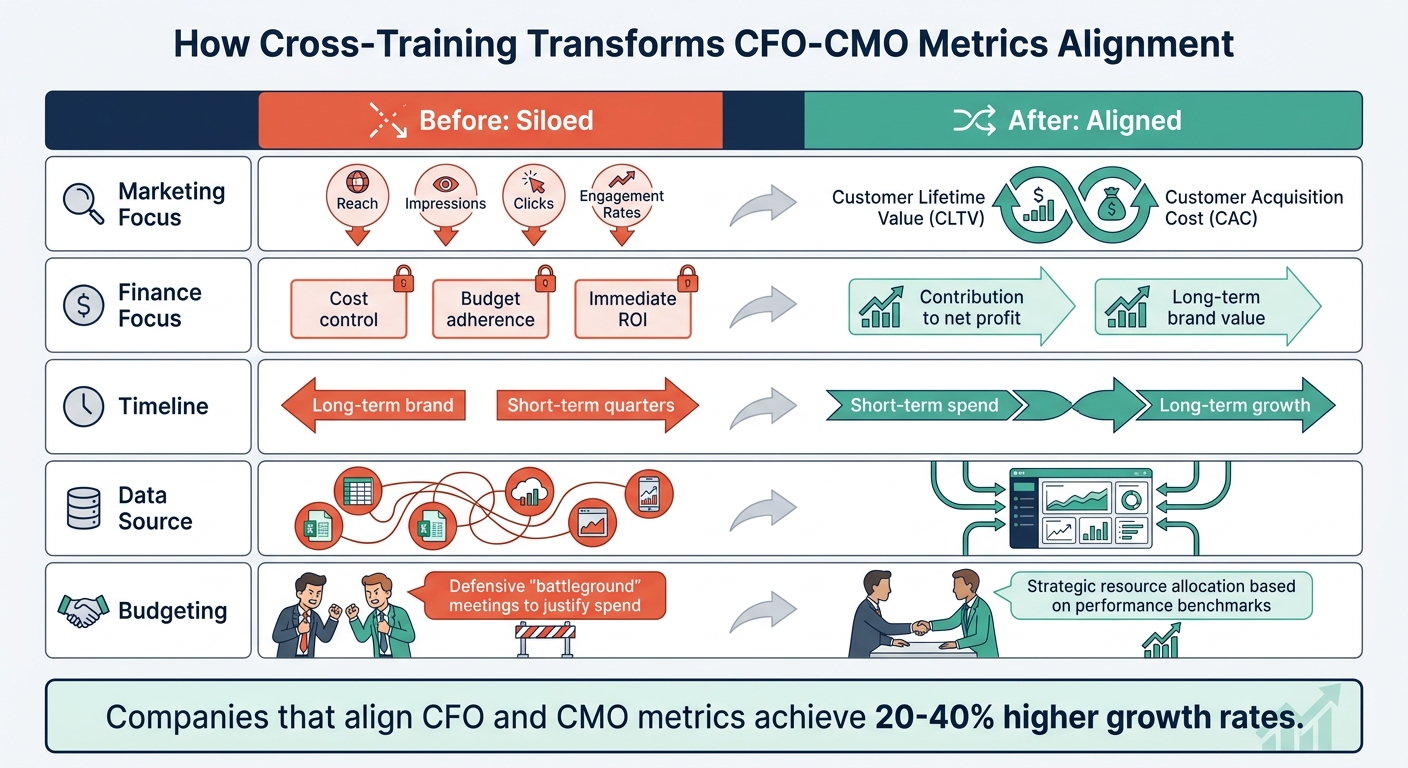
Before vs After CFO-CMO Cross-Training: Metrics Alignment Transformation
When CFOs and CMOs engage in cross-training, they create a shared scorecard that links marketing efforts directly to financial outcomes. This unified focus on measurable results helps drive growth by aligning priorities. The trust and understanding built through cross-training lay the groundwork for this collaboration, allowing shared metrics to seamlessly connect the perspectives of both roles and fuel meaningful progress.
Key Metrics for CFO-CMO Collaboration
Cross-training encourages both teams to prioritize metrics that genuinely impact business scaling, moving away from less actionable data. Two critical metrics take center stage: Customer Acquisition Cost (CAC) and Customer Lifetime Value (CLTV). These metrics form the backbone of strategic discussions. A healthy LTV:CAC ratio - ideally 3:1 - indicates that a customer’s lifetime value should be at least three times the cost of acquiring them. When CFOs and CMOs both grasp this ratio, they can better assess whether growth strategies are sustainable or overly costly.
Another key transformation occurs with Marketing ROI. Instead of relying on vague metrics like clicks or engagement, cross-training ties ROI directly to net profit contribution. This shift is essential because 79% of the fastest-growing companies align their C-suite leaders around shared KPIs. By agreeing on a unified measurement framework, CFOs and CMOs can make quicker, more confident decisions about where to invest resources.
Aligning metrics in this way fosters real-time collaboration and bridges the gap between financial and marketing perspectives, creating a more cohesive approach to decision-making.
Before and After: How Cross-Training Changes Metrics Alignment
Cross-training brings a noticeable shift in how metrics are aligned. Traditionally, marketing and finance operate in silos, with marketing focusing on reach and finance prioritizing cost control. After cross-training, both teams work from a unified data dashboard, offering real-time insights and eliminating the inefficiencies of reconciling separate spreadsheets.
| Metric Category | Before: Siloed | After: Aligned |
|---|---|---|
| Marketing Focus | Reach, impressions, clicks, and engagement rates | Customer Lifetime Value (CLTV) and Customer Acquisition Cost (CAC) |
| Finance Focus | Cost control, budget adherence, and immediate ROI | Contribution to net profit and long-term brand value |
| Timeline | Marketing looks at long-term brand; Finance looks at short-term quarters | Unified view of how short-term spend compounds into long-term growth |
| Data Source | Disconnected spreadsheets and platform-specific dashboards | Unified data dashboard |
| Budgeting | Defensive "battleground" meetings to justify spend | Strategic resource allocation based on performance benchmarks |
Companies that align CFO and CMO metrics achieve growth rates 20% to 40% higher than their competitors. For instance, e.l.f. Beauty showcased the power of this collaboration during fiscal year 2024. CFO Mandy Fields and CMO Kory Marchisotto worked together to reframe marketing as a key sales driver, resulting in 28% sales growth and a 26% increase in adjusted EBITDA. By speaking the same language and tracking the same metrics, they transformed marketing from a perceived cost center into a measurable engine for growth.
How to Implement Cross-Training Programs
Building an effective cross-training program involves structured activities, clear data-sharing practices, and the right tools. Companies that formalize such initiatives often see tangible results. For instance, organizations with strong CFO-CMO collaboration achieve 20% to 40% higher financial growth compared to their peers.
Setting Up Regular Collaboration Activities
The backbone of cross-training is consistent collaboration between finance and marketing teams. Instead of relying on sporadic meetings, establish regular strategy sessions. Monthly or quarterly joint sessions help align long-term goals, while weekly cross-functional huddles address immediate challenges like data inconsistencies or project roadblocks.
Activities like shadowing days are particularly effective. These allow team members to observe each other’s daily workflows, fostering mutual understanding and empathy. Pair this with skill-sharing workshops where team members exchange expertise - finance professionals might teach "Intro to Financial Metrics", while marketers could present on "Digital Marketing Trends".
For more focused efforts, create "tiger teams" - small, cross-functional groups dedicated to specific projects. For example, one global apparel and footwear company implemented a four-part program in 2025. By consolidating agencies and cutting back on non-essential search ads, they redirected savings into social-first content and brand-building, achieving a $70 million boost to their bottom line.
Once these regular interactions are in place, the next step is ensuring seamless data sharing to support ongoing collaboration.
Creating Data-Sharing Protocols
After establishing structured collaboration, transparent data sharing becomes essential. A single source of truth - a centralized dashboard - can eliminate the common "my numbers versus your numbers" debates. Tools like Looker or other business intelligence platforms can consolidate data from various marketing channels, offering insights into 12-month rolling spend trends, platform-specific performance, and budget versus actual spend.
A great example of this is Funnel’s internal collaboration between its marketing and finance teams. Their Looker dashboard enables finance to analyze data by region (e.g., EMEA versus North America) without needing additional reports from marketing. This streamlined process saves time and shifts the focus from tedious reporting to strategic discussions. When both teams work from the same data, trust grows, and budget discussions become more productive.
Using Tools and Advisory Services
The right tools can significantly enhance collaboration and streamline cross-training efforts. Data aggregation platforms automate the integration between CRM, ERP, and digital marketing systems, reducing manual errors and freeing up time for more strategic work. Shared project management tools and communication platforms like Slack help document protocols and maintain transparent communication across teams.
In addition to internal tools, external advisory services can provide valuable guidance. Platforms like The B2B Ecosystem (https://b2becosystem.com) offer consulting and AI-powered tools designed to align marketing and finance strategies. Their resources help CFOs and CMOs bridge the gap, ensuring both teams work toward shared objectives.
"Marketing without finance is guesswork, and finance without marketing is tunnel vision. You need both to turn strategy into impact." - Christopher Van Mossevelde, Head of Content, Funnel
To ensure these cross-training efforts are taken seriously, some companies incorporate inter-departmental feedback into performance reviews. Recognizing and rewarding collaboration ensures these practices are not seen as optional but as an integral part of the company’s culture. With structured processes and measurable outcomes, cross-training can become a cornerstone of organizational success.
Conclusion
Collaboration between CFOs and CMOs is a game-changer for scaling B2B companies. When financial data and marketing insights align, businesses can achieve growth that directly impacts performance. Companies with strong CFO-CMO partnerships often see growth rates soar by 20% to 40%.
Take e.l.f. Beauty, for example. In fiscal year 2024, their CFO-CMO collaboration drove a 28% increase in sales and a 26% rise in adjusted EBITDA. Similarly, a global apparel company reallocated $48 million in savings to high-impact marketing channels, leading to a $70 million boost in profits.
"The smartest growth hack isn't a new channel or trend - it's mastering CFO-CMO cross-functional leadership." - Christopher Van Mossevelde, Head of Content, Funnel
To make this kind of collaboration work, businesses need structured processes, shared goals, and tools that provide a single source of truth. Platforms like The B2B Ecosystem offer consulting and AI-powered resources to help align finance and marketing strategies effectively. With only 20% of CFO-CMO relationships currently considered collaborative, there's a huge opportunity for businesses ready to invest in building these partnerships.
FAQs
What should a CFO and CMO cross-train on first?
CFOs and CMOs can benefit greatly from cross-training, starting with aligning financial metrics to marketing strategies. This approach helps bridge the gap between the two roles, enabling them to work together more effectively. When both sides understand each other's priorities, it becomes easier to drive growth and make smarter decisions about how to allocate resources.
Which shared KPIs best link marketing spend to profit?
Shared KPIs that link marketing investments directly to profit include revenue growth from marketing campaigns and customer lifetime value (CLV). These metrics help bridge the gap between marketing initiatives and financial performance, encouraging closer collaboration between CFOs and CMOs. By prioritizing these KPIs, companies can more accurately assess how marketing strategies contribute to profitability and overall business growth.
How can we prove marketing’s incremental lift to finance?
Demonstrating marketing's financial impact to the finance team requires clear evidence of how collaboration between CFOs and CMOs leads to measurable results. For instance, this partnership often delivers higher ROI, more precise budget planning, and greater brand value.
In fact, data reveals that businesses with strong CFO-CMO alignment can experience 20% to 40% higher growth. This underscores how crucial cross-department teamwork is for driving scalable growth and long-term business success.