Most B2B ad waste happens after the first click, not before it. If your landing page converts at 2% to 3% and your sales cycle runs about 211 days, you need more than one shot to turn traffic into pipeline.
Here’s my simple take: retargeting helps you spend more on people who already showed interest and less on cold traffic that is not ready yet. That usually means higher conversion rates, less wasted spend, and more return from traffic you already paid for through ads, SEO, events, webinars, and outbound.
If you only need the short version, it’s this:
- Cold traffic rarely converts on the first visit
- B2B deals take months and involve multiple people
- Retargeting follows up with warm audiences across channels
- Better segmentation leads to better offers
- Exclusions help cut waste - sometimes by 15% to 20%
- The right KPIs are pipeline-focused, like CPQL and CPO
I’d break the article down into four plain ideas:
- Where ad spend leaks - cold clicks, long sales cycles, and disconnected audience data
- How retargeting works - pixels, CRM lists, behavior-based audiences, and recency windows
- Why ROI improves - warmer traffic is more likely to convert, and past marketing visits get another chance
- How to launch it - set goals, build segments, exclude bad-fit groups, match offers to buying stage, and measure results
One comparison matters most: cold prospecting is for reach, retargeting is for follow-up and conversion. That is the core point, and the rest is execution.
The B2B Advertising Problems Retargeting Solves
Too Much Budget Goes to Cold Audiences
A lot of B2B ad spend gets wasted on cold audiences.
Those leaks usually show up in a few common ways, but retargeting helps fix one big one: broad campaigns spend too much money on people who aren't ready to act yet. The problem comes down to timing. Cold audiences often need more context before they convert, but many campaigns skip that step and go straight to a product pitch or demo request.
Retargeting changes that. It shifts spend toward people who have already shown interest, so each dollar goes to a warmer audience.
Long Sales Cycles Reduce the Value of Single-Touch Campaigns
B2B buying almost never ends after one impression.
Buying committees move on different timelines, and one ad usually won't reach every stakeholder at the right moment. On top of that, each stakeholder tends to need different proof at different points in the process.
That's why single-touch campaigns tend to underperform in B2B. Without repeat exposure across the buying journey, interested accounts can lose momentum before they ever get to a sales conversation. Retargeting adds the continuity that a single impression can't provide.
Fragmented Channels and Poor Audience Data Lower Relevance
B2B buyers move across LinkedIn, Google, industry publications, YouTube, and email. If teams don't bring together first-party data, CRM segments, and behavioral signals, messaging starts to break apart. The same account can end up getting disconnected touches instead of one coordinated sequence.
Poor audience data makes this worse. Weak data pushes retargeting toward broad audiences instead of the accounts and roles most likely to convert. A better move is to unify CRM and behavioral signals - like pricing-page visits or whitepaper downloads - to improve relevance. Those signals then become the audience segments used in cross-platform retargeting.
sbb-itb-01010c0
The B2B Retargeting Strategy 90% of Companies Are Missing
How B2B Retargeting Works Across Channels and Buying Stages
Once your audience data sits in one place, the next move is simple: turn that data into retargeting groups based on behavior and buying stage.
From Site Visit to Retargeting Audience
Retargeting starts with a tracking pixel - a small code snippet placed on your site. When someone lands on a page, the pixel logs that visit anonymously, and the ad platform uses those actions to build audiences. You can also use list-based retargeting by uploading CRM or newsletter lists and matching them across devices and social networks [1].
The key is segmentation. Group people by the pages they visited, the actions they took, and how recently they engaged. Someone who spent time on your pricing page is in a very different spot than someone who glanced at a blog post. A 30-day lookback window helps keep the message timely [1].
Segment by Account Priority and Buyer Intent
Not every retargeting audience should get the same message. The point is to group visitors by account priority, behavior, and buying stage so the message fits where they are.
Here’s a simple framework:
| Funnel Stage | Target Audience | Offer |
|---|---|---|
| Awareness | Target accounts | Industry report |
| Consideration | Engaged visitors | Case study |
| Decision | High-intent visitors | Demo request |
You can narrow each group even more with firmographic filters like company size, industry, and job title. LinkedIn's Matched Audiences also lets marketers retarget website visitors or sync CRM lists for tighter account-based targeting [3].
Those segments matter, but they only pay off when people see the same message across channels.
Use Cross-Platform Delivery to Reinforce the Same Message
Cross-platform retargeting keeps the message aligned across LinkedIn, Google Display, and YouTube through the sales cycle. That repeated exposure helps reinforce intent at each stage of the buying journey.
That consistency sets up the conversion and acquisition-cost gains covered in the next section.
How Retargeting Improves B2B Ad ROI
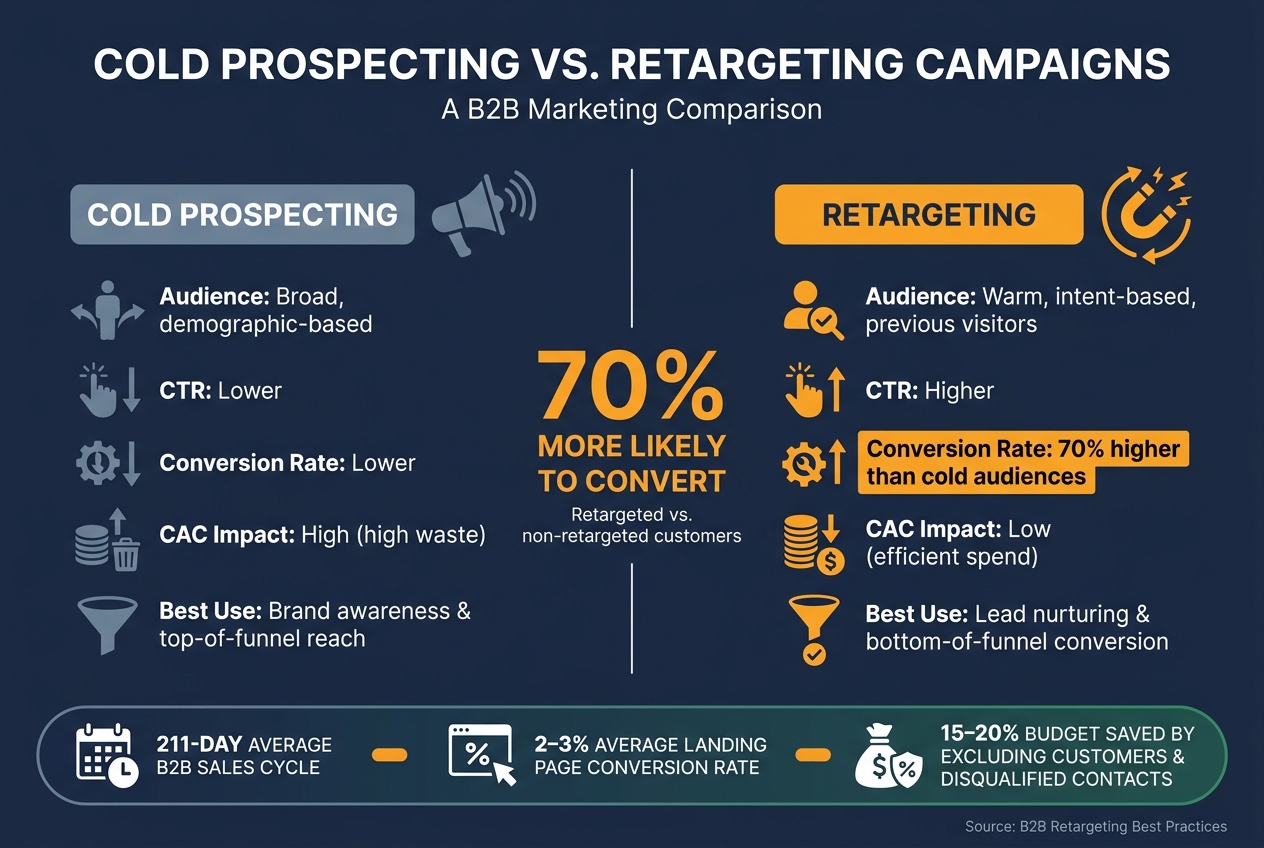
B2B Retargeting vs. Cold Prospecting: ROI Comparison
Higher Conversion Rates and Lower Acquisition Costs
Once you segment audiences and reach them across channels, the ROI lift starts to show up. Retargeting improves ROI because it moves budget away from cold impressions and toward warmer, higher-intent audiences. Retargeted customers are 70% more likely to convert than non-retargeted customers [1].
Cold campaigns cast a wide net. That often means paying to reach people who were never likely to convert in the first place. Retargeting works differently. It puts spend behind accounts that have already shown interest, which cuts waste and drives more qualified opportunities per dollar.
Better Returns From Existing Content, SEO, Events, and Outbound
Retargeting helps you recover demand that other channels already created but didn't convert. Every webinar, blog post, event, and outbound sequence brings in traffic. The issue is simple: many visitors leave before taking action. Without retargeting, part of that spend slips away.
Say someone finds your site through organic search and reads a thought leadership piece. You can bring that person back with a LinkedIn case study ad. Or maybe someone joined a webinar but didn't book a meeting. You can re-engage that contact through list-based retargeting using attendee or CRM data. Same initial touchpoint, second shot at conversion.
That's where the math starts to look better. Instead of asking each channel to convert on the first visit, retargeting gives your earlier marketing work another path to produce pipeline.
That difference stands out most when you compare cold prospecting with retargeting side by side.
Cold Prospecting vs. Retargeting: Performance Comparison
Table: Cold Prospecting Campaigns vs. Retargeting Campaigns
| Campaign Type | Audience Definition | Typical CTR | Typical Conversion Rate | CAC Impact | Best Use Case |
|---|---|---|---|---|---|
| Cold Prospecting | Broad, demographic-based | Lower | Lower | High (high waste) | Brand awareness and top-of-funnel reach |
| Retargeting | Warm, intent-based, previous visitors | Higher [1] | 70% higher than cold [1] | Low (efficient spend) | Lead nurturing and bottom-of-funnel conversion |
The next step is launching with clear goals, audience rules, and exclusions.
A Simple Framework to Launch and Measure Retargeting
Set Goals, Audiences, and Exclusions Before Launch
If retargeting is already beating cold prospecting, the next move is simple: launch it with a clean way to measure results.
Start with pipeline goals, not vanity metrics. For B2B retargeting, CPQL and CPO matter more than CPC [3]. A cheap click doesn't mean much if it never turns into pipeline.
Once your KPIs are clear, build the audiences around them. Use site behavior and CRM lists to create your retargeting pools. Then cut out the people who shouldn't see these ads:
- Customers
- Active pipeline
- Disqualified contacts
That one step can save money fast. Excluding those groups can prevent 15-20% of your budget from going to irrelevant clicks [2].
Match Creative and Offers to Buying Stage
Your ad should match where the buyer is in the process. That's how each impression does a job instead of just taking up space.
| Buying Stage | Creative Format | Offer or CTA |
|---|---|---|
| Awareness (Top of Funnel) | Video Ads, Document Ads | Industry reports, frameworks, educational guides |
| Consideration (Middle of Funnel) | Carousel Ads, Case Studies | Product demos, ROI calculators, comparison guides |
| Decision (Bottom of Funnel) | Lead Gen Forms, static image ads | Book a demo, free trial, custom quotes |
Keep the message aligned across LinkedIn, display, and any other channel in the mix. If someone sees one promise on LinkedIn and a different one elsewhere, the whole thing starts to feel sloppy.
Frequency capping matters too. Limit how often one person sees your ads so you don't wear people out or hurt brand perception [1]. Then give the campaign enough time to do its job. Let it run for 2-4 weeks and hit at least 50 conversions before making major changes.
Conclusion: Retargeting Turns Wasted Traffic Into Measurable Pipeline
Retargeting gives B2B teams a way to turn early traffic into a second shot at conversion. It re-engages high-intent accounts across channels by using CRM data, behavioral signals, and buying-stage segmentation to keep the message relevant. When the program is segmented and tied back to CRM data, it can drive more pipeline from the same budget you're already spending.
FAQs
When should B2B companies start retargeting?
B2B companies should start retargeting as soon as prospects engage with their website or digital content but don’t complete a desired action - like requesting a consultation, downloading a whitepaper, or making a purchase.
Here’s why that timing matters: B2B sales cycles often run nine to eighteen months. That’s a long gap. If you wait too long, your brand can fade from memory before an RFP is even issued.
Early engagement keeps your company in view during that long decision window. And once prospects start interacting, behavioral data can help spot high-intent visitors so sales and marketing teams can follow up with messaging that fits what those people already showed interest in.
Which audience segments perform best?
The best-performing B2B audience segments usually come from three things: behavioral data, firmographics, and buying-stage signals.
In practice, the highest-intent groups often drive the strongest ROI. That includes people who visited key pages on your site, requested demos, or attended webinars. Add firmographic filters like company size, industry, and seniority, and you can narrow your focus to the people most likely to make the call.
How long does retargeting take to improve ROI?
B2B retargeting tends to improve ROI over time - not overnight. B2B buying cycles are often long, so it may take weeks before you see results you can trust.
On LinkedIn, the platform usually needs 2 to 4 weeks and at least 50 conversions to optimize.
Hold off on making changes during the first two weeks. Early cost-per-lead numbers can point you in the wrong direction. After that, review performance every two weeks, and give any budget or strategy update at least two weeks to show meaningful results.