In niche B2B, the best influencer is often not the person with the biggest audience. I’d look for people with a small but tight group of buyers, clear subject-matter depth, and a track record of getting peers to pay attention.
Here’s the short version:
- I start with audience fit - job titles, industry, and company size
- I screen for buyer trust signals - speaking spots, peer mentions, and strong comments
- I search where buyers already learn - LinkedIn, newsletters, podcasts, Slack groups, GitHub, and industry hubs
- I rank names before outreach so I don’t waste time
- I use teaching-based partnerships - webinars, guides, interviews, and newsletter placements
- I track results with UTMs, landing pages, and CRM data
- I keep a roster so one campaign can turn into a repeatable program
A simple rule I’d use: if a person has 5,000 to 30,000 followers and the audience is packed with decision-makers, that can beat a much larger account. And if comments from the last 30 to 90 days show the right roles - like CISOs, VPs, compliance leads, or heads of ops - that’s a much better sign than raw reaction counts.
What matters most is simple: find the people your buyers already trust, check that their audience matches your ICP, then build one clear partnership tied to pipeline.
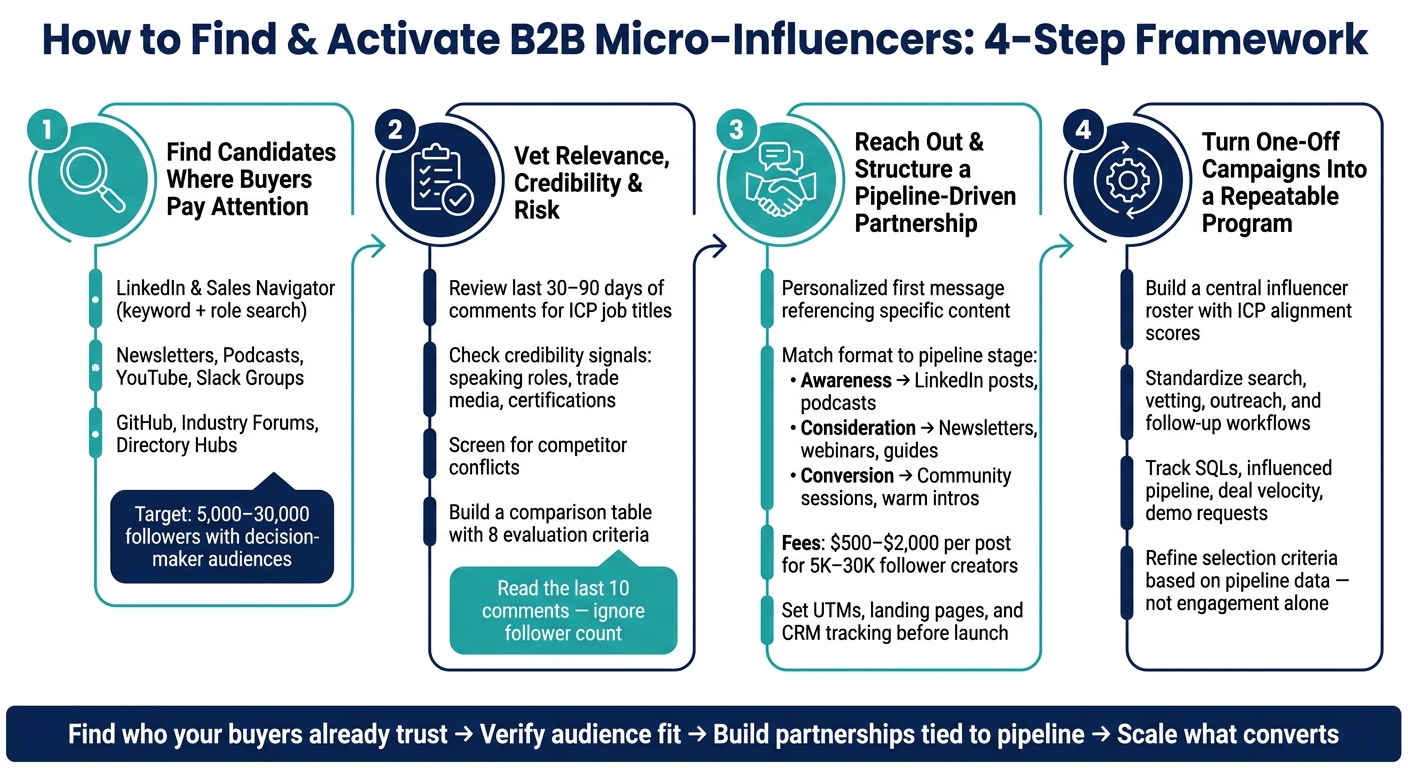
How to Find & Activate B2B Micro-Influencers: 4-Step Framework
How to architect B2B influencer marketing for pipeline, not just impressions, with Justin Levy
sbb-itb-01010c0
Step 1: Find Candidates Where Niche B2B Buyers Already Pay Attention
Find people in the places niche buyers already use to learn, talk shop, and pressure-test ideas. Most specialized B2B buyers don't depend on broad social feeds. They follow a smaller set of trusted channels. So start there, then build your shortlist around the names that keep showing up.
Search LinkedIn, Sales Navigator, and Industry Keywords
Use LinkedIn to find your first set of names, then check those names in other channels. Start with tight role and topic searches. Pair job titles with topic keywords - for example, "MedTech compliance officer" or "SaaS pricing strategy" - in LinkedIn's content search. That helps you find people who are actively writing about a topic, not just mentioning it on a profile.
Look for LinkedIn "Top Voice" badges in your niche as a quick credibility signal [1]. When you find one strong candidate, use the "More Profiles for You" sidebar to spot similar voices with overlapping audiences [2]. Sales Navigator can help you track activity and pick up stronger engagement signals [2]. A comment from a VP of Engineering or CISO tells you more than a big like count [3].
If LinkedIn only turns up a small number of strong names, branch out to newsletters, podcasts, and niche communities.
Review Newsletters, Podcasts, YouTube Channels, and Niche Communities
Outside LinkedIn, many trusted B2B micro-influencers show up in more than one format. Check Substack for newsletters with steady, technically grounded writing in your category. Review podcasts, YouTube channels, and event speaker lists for recurring guests and speakers who already have peer trust. A speaking slot at an industry webinar or conference is a strong signal because it often means someone else has already vetted that person's expertise [3].
Slack communities, GitHub repositories, and technical forums can also be useful. In these spaces, practitioners earn trust through direct peer discussion, not showmanship. Put more weight on candidates whose audience shows trust through substantive comments, repeat engagement, and mentions from other recognized names in the space.
Use directories and resource hubs to add more names to the shortlist.
Use Directories and Resource Hubs to Widen Your Shortlist
After you've built an initial list through direct search, use structured resource hubs to widen it. The B2B Ecosystem maps operators, solution providers, publications, and communities across the B2B landscape. That makes it a practical tool for finding people and brands that appear again and again across directories, media properties, and active communities.
When the same name shows up in several places - a directory listing, a newsletter byline, a community role - that's a strong sign of cross-channel presence worth a closer look. Use these hubs to expand your shortlist, not to qualify candidates, and keep track of where each name appeared before outreach.
Step 2: Vet Relevance, Credibility, and Risk Before Outreach
Once you’ve found names that already have buyer attention, the next job is simple: make sure they reach the right buyers. This is where you trim the list using audience fit, credibility, and risk checks. In B2B, loose screening burns time and budget fast.
Check Audience Fit and Content Relevance
Start with the last 30 to 90 days of comments. Look for job titles, seniority, and company types that line up with your ICP.
Then check content-audience alignment. This part matters more than people think. Someone may post about enterprise sales, but if most of the commenters are junior consultants or career coaches, the fit is off. The topic may look right on the surface, but the audience isn’t where you need it to be.
You can also ask people on your shortlist for audience data. Screenshots from LinkedIn Analytics, Shield, or a newsletter platform can help confirm job title mix and industry concentration.
Audience fit comes first. After that, credibility and engagement depth tell you whether the partnership has a real shot.
Measure Credibility and Engagement Depth
In B2B, authority usually shows up in plain ways: trade media mentions, event speaking roles, certifications, and direct practitioner experience. Those signals carry more weight than raw reach alone.
Engagement quality also matters more than engagement volume. A post where senior operators debate how to handle implementation details is much stronger than a post with hundreds of empty reactions.
A simple test helps here: read the last 10 comments without checking follower count. If the discussion still feels relevant and useful, keep that person on the list.
Also watch for too many paid promotions. If someone keeps promoting competing tools or low-quality products, that can hurt their standing with a professional audience.
Build a Comparison Table for Your Shortlist
After you’ve screened each candidate, put them side by side. A comparison table makes decisions clearer and gives other stakeholders a clean way to weigh in.
| Evaluation Column | What to Look For |
|---|---|
| Platform & Format | Primary channel, such as LinkedIn, Substack, or podcast, and content style, such as technical or thought leadership |
| Audience Size and Concentration | Total size and how tightly the audience clusters around your target vertical or role |
| Audience Roles | Job titles and seniority of followers and commenters |
| Industry Focus | Vertical and sub-niche match with your ICP |
| Engagement Quality | Share of substantive peer comments versus generic reactions |
| Credibility Signals | Speaking roles, trade media mentions, certifications, and "Top Voice" badges |
| Competitor Conflicts | Current or recent partnerships with direct competitors |
| Partnership Fit | Match with your messaging, tone, and campaign goals |
Fill this out for every candidate before outreach. It keeps decisions tied to criteria instead of gut feel. It also gives you a clean record of why you moved ahead with a name - or passed on it.
Use the finished table to rank the small group that’s worth contacting.
Step 3: Reach Out and Structure a B2B Partnership That Drives Pipeline
Once you have a ranked shortlist, outreach is the next move. But the shortlist only matters if your outreach lines up with the niche audience you already checked.
Write a Personalized First Message With a Clear Use Case
Before you send a message, spend a little time with the person's content. Like posts. Leave comments that add something. Share a post with a short note that shows you paid attention. The goal is to show up as a peer, not a vendor. That same idea should shape the format you pitch.
When you reach out on LinkedIn or by email, mention something specific. Call out the exact post, newsletter issue, or talk that got your attention, and say why it connected with your team's work. Then tie it to a clear use case: why would their audience care about what you're building?
Keep it short. Ask for one thing only, like a co-authored whitepaper, a live interview, or a technical webinar. And make the upside clear for their audience - not just for you.
Prioritize practitioners who speak from real operating experience.
Choose Collaboration Formats That Fit Complex B2B Buying Journeys
B2B buying cycles take time. More than one stakeholder usually needs to get comfortable before anything moves. So the formats that work best tend to teach, not pitch.
Match the ask to the stage you need to move.
| Pipeline Stage | Best-Fit Formats | Primary Metric |
|---|---|---|
| Awareness | LinkedIn posts, co-created LinkedIn posts, podcast appearances, speaking roles | Reach, reshares, mentions |
| Consideration | Newsletters, webinars, technical guides | CTR, newsletter opt-ins, saves |
| Conversion | Private community sessions, warm introductions, demo requests | Pipeline influence, opportunity creation |
Use educational formats that help buyers build agreement across stakeholders.
Set Terms, Fees, and Metrics in Advance
Before any content goes live, get the basics in writing. A simple agreement should cover deliverables, review steps, claims approval, exclusivity windows, and timelines. If this part stays fuzzy, friction shows up later - especially when legal or compliance teams step in.
On pay, B2B micro-influencer rates for creators with 5,000-30,000 followers usually fall between $500-$2,000 per post [4]. On top of flat fees, you can add performance bonuses tied to influenced pipeline, or offer noncash perks like early access, executive briefings, or beta access.
For tracking, set up unique UTM parameters and dedicated landing pages before launch. Then connect that data to your CRM so you can trace a contact from first click to closed deal. Agree on the metrics up front, including SQLs, influenced pipeline, deal velocity, revenue impact, and demo requests.
Document these terms now so the program can be repeated cleanly in Step 4.
Step 4: Turn One-Off Outreach Into a Repeatable Influencer Program
Document the Search, Vetting, and Outreach Workflow
Turn your first partnership into a program your team can run again and again.
Once the first campaign works, standardize the process so the next one is faster to launch and easier to measure. One win is nice. A documented process is what lets you do it at scale.
Start with a central influencer roster. For each vetted candidate, log their niche, platform, ICP alignment score, and past campaign performance. Keep it in a shared roster your team can update as results come in.
The table below shows how to standardize each part of the workflow:
| Process Stage | Standardization Tool/Method | Key Metric/Output |
|---|---|---|
| Search | AI-assisted screening and LinkedIn Sales Navigator | Audience fit |
| Vetting | Standardized checklist (credibility, safety, reliability) | ICP Alignment Score |
| Outreach | Personalized templates and vetting calls | Response and conversion rate |
| Follow-up | CRM tracking | Pipeline influence |
| Repurposing | Modular content set (email, ads, webinars) | Asset reuse efficiency |
Treat influencer content like a repeatable workflow, not a one-time experiment.
Use the same framework to decide which partners stay in rotation and which ones drop out.
Refine the Program Using Pipeline Results
Once you have data from a few campaigns, look at what actually moved the needle. Compare which formats, platforms, and profiles drove pipeline. Which formats led to demo requests? Which influencers generated SQLs? Where did deal velocity improve?
Those answers should shape your next round of decisions. Update your selection criteria and move budget toward what performed. An influencer who drove strong LinkedIn engagement but no pipeline movement is not the same as one whose newsletter mention converted qualified leads. Pipeline and deal data should guide what you scale - not top-of-funnel numbers alone.
After each campaign, update the roster with what drove real pipeline, not just engagement.
Conclusion: Focus on Trust, Fit, and Repeatability
The whole process comes down to five moves: define your niche audience clearly, search in the right professional channels, vet candidates with B2B-specific criteria, build partnerships that support the buyer journey, and document everything so the program can scale. Each step builds on the last. Find the right niche, vet for credibility, and systematize what converts.
FAQs
How do I verify influencer audience fit?
Look past follower counts and focus on intent and behavior. Check the comments and see who’s showing up. Are practitioners, decision-makers, and industry peers having real conversations? Or is it mostly generic one-liners and empty reactions?
You’ll also want to confirm that the audience lines up with your Ideal Customer Profile. Look at job titles, company size, and seniority. Small signals - like newsletter sign-ups or community memberships - can point to trust and a stronger match with the audience you want to reach.
What if my niche has few micro-influencers?
In niche B2B markets, that’s normal - focus on relevance over reach. Put your energy into trusted experts like consultants, analysts, and active community moderators who have strong standing in your vertical.
If there aren’t many direct influencers, widen the lens a bit. Check adjacent sectors that serve the same audience. You can also look at industry hashtags, your engaged followers, and people who write for niche journals or post in professional forums.
In specialized B2B, a small, qualified audience often brings more value.
How long should I test before measuring pipeline impact?
Start with a small test activation before you commit to a bigger strategy. In B2B, there’s no single standard timeframe for measuring pipeline impact.
Set clear, time-bound KPIs before launch. Then review results monthly or quarterly, with close attention to lead generation and conversion rates.