Instagram can help drive B2B demand - but only if I treat it like a trust and pipeline channel, not a vanity play. The article’s core point is simple: I need to tie Instagram influencer work to a funnel goal, pick niche experts over broad reach, match content formats to buyer stage, and track results all the way to CRM and revenue.
Here’s the short version:
- Start with the goal - awareness, leads, pipeline influence, or expansion
- Pick the right people - analysts, operators, consultants, and niche creators with buyer fit
- Use the right format - Reels for reach, Carousels for education, Stories for clicks, Lives for bottom-funnel Q&A
- Build sequences, not one-off posts - B2B buyers need repeat exposure
- Track more than likes - use UTMs, landing pages, CRM attribution, and promo codes
- Handle disclosure and approvals early - FTC rules, usage rights, review steps, and ad permissions need to be set before launch
A few numbers frame the case: 87% of B2B executives use social platforms to vet vendors, 83% of Instagram users say they learn about new brands or services there, and 82% of top B2B influencer programs run always-on programs. So if I want Instagram to help sales, I need a clear goal, a tight audience, and measurement that goes past engagement.
These B2B Influencer Marketing Mistakes KILL Campaigns
Quick comparison
| Area | What the article says to do |
|---|---|
| Goal | Set funnel stage and KPI before outreach |
| Creator choice | Prioritize audience fit and subject-matter depth over follower count |
| Content | Teach, explain, and show proof instead of pushing hard-sell posts |
| Cadence | Use repeat touches and campaign sequences |
| Measurement | Track reach, clicks, leads, pipeline, and closed-won revenue |
| Compliance | Use paid partnership disclosure and clear contract terms |
If I boil the full guide down to one line, it’s this: B2B influencer marketing on Instagram works best when I run it like a demand gen program, not a brand stunt.
Build the Strategy Before You Buy Posts
Once the goal is clear, build the operating plan before you brief creators. Set your goals, audience, and budget before you start reaching out.
Set Objectives, Funnel Stage, and KPIs
Your campaign goal should drive creator selection, content format, and measurement. Start with the funnel stage, then pick metrics that match the result you want.
| Funnel Stage | Instagram Content | KPIs That Matter |
|---|---|---|
| Awareness | Reels, influencer takeovers | Reach, impressions, brand mentions |
| Consideration | Carousels, Stories with link stickers | Saves, UTM-tracked link clicks, webinar sign-ups |
| Decision | In-app lead forms, case study videos | Demo requests, sales-qualified leads (SQLs), conversion rate |
| Expansion | Customer success stories | Referral traffic, brand advocacy |
Follower count matters less than qualified traffic, influenced pipeline, and sales meetings. That's the part many teams miss. A big audience looks nice in a screenshot, but it doesn't tell you whether the campaign moved buyers.
Build reporting around reach, leads, and pipeline influence from day one. And use UTM parameters on every influencer link so you can see what's driving results.
Those KPIs only make sense when the audience and offer fit the funnel stage.
Define Audience, Offer, and Budget
Get specific about who you want to reach. Segment by seniority, industry, and pain point - not just job title. Instagram reaches B2B buyers early in their research [8].
"Instagram is not just a platform for sharing videos and photos... it is a platform where you can build your presence to reach young targets, create brand awareness, and stay connected with existing customers." - Rahul Pandey, Rahulogy [1]
Your offer should fit the funnel stage too. For awareness, Reels can introduce your brand identity. For decision-stage campaigns, in-app lead forms can connect to free trials or demo requests. Keep the message plain and story-led, not stuffed with corporate copy.
On budget, most campaigns use one of three payment models:
- Flat fees
- Performance-based commissions tied to tracked links or lead form fills
- Hybrid deals that combine both
Micro-influencers with 10,000 to 100,000 followers often land in the $100 to $1,000 per post range, while macro-influencers with 100,000 to 500,000 followers can cost $1,000 to $10,000 per post [6][5]. Reels often cost more because they take more time to produce [7].
Use Research Hubs and Advisory Tools to Cut Guesswork
Before you scale spend, test your assumptions. Make sure your audience is on Instagram, your offer lines up with current pain points, and the market is big enough to justify the spend.
Use The B2B Ecosystem to validate targeting, sharpen positioning, and size TAM before you spend. Doing that work up front helps cut wasted spend.
82% of the most successful B2B influencer programs run an always-on strategy instead of one-off campaigns [2]. So your audience definition, offer, and budget model need to work over time - not just for a single launch.
With that plan in place, the next step is picking creators and partnership models that line up with these targets.
sbb-itb-01010c0
Choose the Right Influencers and Partnership Model
Pick creators whose audience lines up with your buyers. That choice decides whether Instagram builds trust or just piles up impressions. If the partner already shapes how your buyers think, the campaign has a shot. If not, you're paying for noise.
Find B2B Influencers With Relevant Audiences
Start with niche hashtags, LinkedIn thought leaders who are also active on Instagram, and conference speaker lists.
In B2B, audience fit matters more than follower count. A creator with 5,000 enterprise buyers can beat a generalist with 500,000 mixed followers [4].
"The best B2B creators are practitioners first and creators second." - AJ Eckstein, Founder & CEO, Creator Match [9]
Evaluate Credibility, Engagement Quality, and Content Fit
Before you reach out, review the last 30 to 90 days of content. Don't stop at likes. Look for saves, shares, detailed comments, and interaction from people who work in the field. That kind of peer response is a stronger trust signal than surface-level engagement.
Use vetting tools to check audience demographics and flag suspicious engagement.
Then look at content fit by format. Can this creator break down a complex offer through educational Carousels, practitioner-led Reels, or interactive Stories? Also check for conference talks, podcast appearances, or other signs of real-world authority [9].
| Influencer Type | Trust Level | Reach | Cost | Content Depth |
|---|---|---|---|---|
| Employee Advocates | Very High | Low-Medium | Low (Internal) | Deep/Technical |
| External Industry Experts | High | Niche/Targeted | High | Very Deep |
| Niche Creators | Medium-High | High (in niche) | Medium | Educational/Visual |
Structure Outreach, Briefs, and Long-Term Relationships
Use email or a website form instead of relying on DMs alone. Put "Paid partnership opportunity" in the subject line, and mention specific posts so the outreach doesn't feel generic.
Your brief should spell out the campaign goal, target audience, deliverables, review process, timeline, and payment terms. Give creators guardrails, but don't script every word. Too much editing strips out the voice that made them worth hiring in the first place.
For payment, flat fees, commissions, or a hybrid model can all work. In many cases, repeat partnerships do better than one-off posts.
These choices should guide the content format, posting rhythm, and CTA setup in the next phase.
Design Instagram Campaigns That Match B2B Buying Behavior
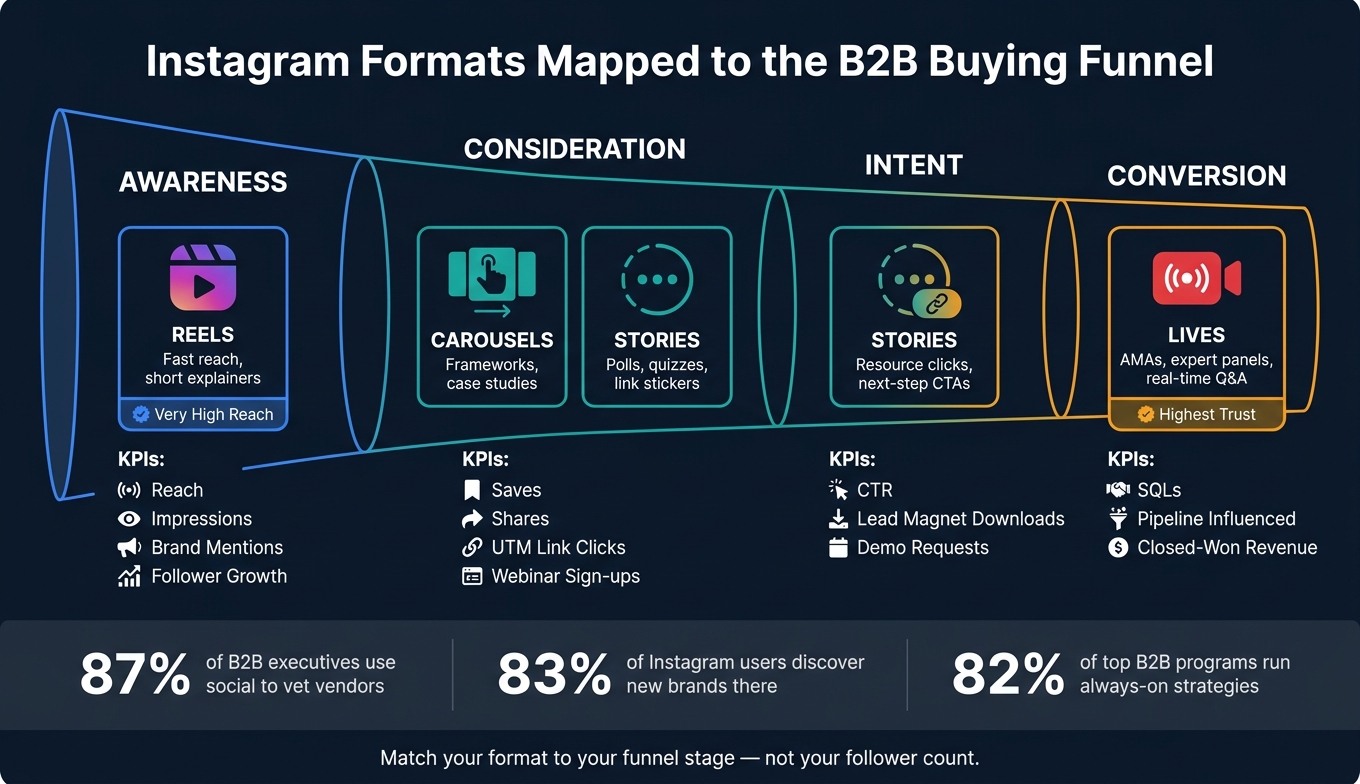
B2B Instagram Influencer Marketing: Format vs. Funnel Stage Guide
After you pick the right creators, the next step is simple: match each format to the buyer stage you want to influence.
Match Content Format to Campaign Goal
Each Instagram format plays a different role in the B2B buying journey.
Reels are best for awareness. They get fast reach with very little effort from the viewer. That's what makes them useful at the top of the funnel.
Carousels go deeper. They're a strong fit for breaking down a technical framework, walking through a case study, or turning a whitepaper into a swipeable guide. They also tend to get more engagement than single-image posts [10].
Stories help move buyers into consideration. Polls, quizzes, and link stickers make them a good fit for webinar sign-ups, resource clicks, and other next-step actions.
Lives build the most trust, even if fewer people join in real time. Use them for AMAs, expert panels, and high-intent conversations where people want direct answers.
| Format | Reach | Content Depth | Interactivity | Best Funnel Stage |
|---|---|---|---|---|
| Reels | Very High | Low (short explainers) | Medium | Awareness (Top) |
| Carousels | Medium | High (frameworks, cases) | Medium | Consideration (Mid) |
| Stories | Medium | Low to Medium | Very High (polls, links) | Consideration / Intent |
| Lives | Low | Very High (AMAs, events) | High (real-time Q&A) | Conversion (Bottom) |
Build Content Pillars and Campaign Sequences
Three content pillars line up well with how B2B buyers move:
- Educational thought leadership: micro-lessons, frameworks, and data drops
- Proof and validation: customer results, third-party reviews, and practitioner takes
- Culture-led content: behind-the-scenes posts, team spotlights, and event coverage
The key is to use these pillars in sequence, not as one-off tactics.
A simple launch flow might start with a Reel from an industry expert that frames the problem. Then you follow with a Carousel that explains the solution. After that, a Story series can push people to a demo or resource with a link sticker.
SAP's campaign with 11 industry influencers across LinkedIn and Instagram shows what this kind of sequencing can do. It reached more than 80 million people, drove 1.5 million engagements, and brought in 80,000 live viewers at their conference [3].
Set Cadence, Timing, and Calls to Action
Plan for repeat exposure. A single post usually won't move a B2B buyer.
For U.S. professional audiences, 11:00 a.m.-1:00 p.m. and 6:00-8:00 p.m. often produce stronger engagement. Still, treat those windows as a starting point and test by audience segment [10].
Every asset should have a CTA that matches its funnel stage. For example:
- Save for educational Carousels
- Link stickers for traffic
- Register for events
- Book Now for consultations
Kittl pushed this further with automated keyword triggers in Reel comments. Viewers were asked to comment a keyword in exchange for a tracked link. That small move turned passive viewers into active trial sign-ups [2]. It's a smart test for any B2B campaign because it lowers friction without making the ask feel heavy.
Use the same format-to-stage logic when you track results in the next section.
Measure Results, Manage Compliance, and Build a Repeatable Operating Model
Track Performance From Reach to Pipeline Influence
Once your content and CTAs are live, measurement and compliance are what let the program scale. A lot of B2B teams stop at reach and engagement. That leaves a big blind spot. The point here is to connect influencer activity to pipeline.
After you lock in format and CTA choices, the next job is simple: figure out whether the campaign moved buyers. Your measurement stack doesn't need to be complicated. Use UTM parameters on every link, set up unique landing pages for each influencer, add promo codes for direct conversions, and connect everything to your CRM so leads map back to specific creators. Also, don't just look at volume. Check audience quality by seeing whether engaged users match your ICP by role and seniority.
Map KPIs to each funnel stage so you're tracking the right signals at the right time:
| Funnel Stage | Key KPIs | How to Track |
|---|---|---|
| Awareness | Reach, Impressions, Mentions, Follower Growth | Instagram Insights, Social Listening Tools |
| Engagement | Saves, Shares, Comment Quality, CTR | Instagram Insights, UTM Parameters |
| Conversion | Demo Requests, Lead Magnet Downloads, Trial Sign-ups | CRM Attribution, Unique Landing Pages |
| Revenue | Pipeline Influenced, Closed-Won Revenue, ROI | CRM Integration, Promo Codes, Affiliate Links |
With reporting in place, the next limit is governance.
Handle FTC Disclosure and Internal Review Requirements
FTC rules are non-negotiable. If there's a paid or sponsored relationship of any kind, it must be disclosed clearly and conspicuously. Use the Paid Partnership label, plus a clear caption, on-screen, or verbal disclosure for each format.
| Format | Disclosure Method | Placement & Execution Notes |
|---|---|---|
| Feed Posts | Paid Partnership Label + #ad | Label at the top; include #ad within the first 3 lines of the caption |
| Reels | Paid Partnership Label + Caption Disclosure | Make the label visible in the Reel and include #ad in the description |
| Stories | Paid Partnership Label + Text Overlay | Place disclosures away from UI elements and use high-contrast text |
| Lives | Verbal Disclosure + Pinned Comment | State the partnership at the start and pin a disclosure comment |
Before anything goes live, put the basics in the contract: deliverables, timelines, usage rights, exclusivity, review steps, and whitelisting rights for paid partnership ads. Treat compliance as part of scale, not as a legal side note. That's what helps a program hold up over time.
Clean attribution and clear review rules are what turn a one-off campaign into a repeatable operating model.
Conclusion: A Practical Playbook for Scaling B2B Instagram Influencer Programs
The operating model comes down to four disciplines: funnel-aligned goals, influencer selection based on audience fit and credibility, Instagram formats that teach and show rather than just sell, and attribution that runs from reach to pipeline influenced. That's what makes the channel scalable - not the size of your influencer roster.
FAQs
How do I choose the right B2B influencers on Instagram?
Put audience quality and niche authority ahead of follower count. The better filter is the 4 R’s: Relevance, Reach, Resonance, and Reputation.
Pick influencers whose audience lines up with your ideal customer profile - especially job title, seniority, and industry. Then look at the comments. Are real decision-makers and working practitioners adding useful thoughts, or is it mostly empty praise? That quick check tells you a lot about the kind of audience they’ve built.
What budget should I expect for a B2B Instagram influencer campaign?
B2B Instagram campaign budgets can swing a lot, but micro-influencer partnerships often land between $2,000 and $10,000. In B2B, pricing usually has less to do with follower count and more to do with the work involved - things like research, messaging, revisions, and the extra time it takes to make more complex content.
In practice, costs might be a few hundred dollars for a single asset or several thousand dollars for a longer engagement. It also helps to set aside budget to promote the content once it goes live.
How can I measure Instagram influencer ROI beyond likes?
Track conversions and revenue, not just engagement. Use unique affiliate links, promo codes, and UTM parameters to tie traffic, sales, and conversion paths back to specific creators.
It also helps to look at lead quality - not just volume. Check sign-ups, form completions, and trial starts to see which creators bring in people who are more likely to buy.
For mature programs, use multi-touch attribution to measure influencer impact across long B2B sales cycles. You can also include earned media value to estimate total exposure.