Find B2B influencers on X (formerly Twitter) by buyer fit, not follower count. Start with buyer problems, industry keywords, and event conversations. Check who shares useful answers - and whether the people replying match the buyers you want to reach.
Turn those names into a shortlist in 3 steps:
- Find: Search X, industry publications, podcasts, and conference agendas for experts in your niche.
- Check: Review recent posts, audience roles, and reply quality. Score candidates from 1–5 and track post links, fit notes, and contact details.
- Connect: Join relevant discussions, then send a clear proposal covering the work, timing, and pay. Set disclosure requirements for paid partnerships.
Recheck accounts before outreach and launch. Judge progress by buyer conversations, not follower growth.
B2B Influencer Scoring: Buyer Fit Over Follower Count
How to Find Top B2B Influencers in MINUTES
sbb-itb-01010c0
1. Set Your Criteria and Find Candidates
Set buyer-fit requirements before collecting names. Start with a short list, then narrow it as you check each candidate’s fit.[1] Keep individual experts separate from media brands so your search stays focused on potential expert partners. Use the filters below to rank candidates.
Define Your Buyers and Campaign Goals
Define the buyer roles, firmographics (industry, company size, revenue, and location), pain points, and decision-makers your campaign needs to reach.
Choose a primary goal: brand awareness, website traffic, lead generation, or revenue. Then set requirements for expertise, audience fit, evidence that supports their claims, honest communication, and engagement. Tie each success metric to that primary goal.
Search X for Topics and Buyer Conversations
Use X search and social listening to track industry terms, buyer problems, product categories, event names, and relevant hashtags. Compare each person’s bio with recent posts. Their claimed specialty should show up in what they publish.
Check replies, quote posts, and mentions to find specialists beyond the most visible accounts. Look for people who explain problems and answer detailed questions, rather than just sharing industry headlines. These exchanges help you find experts who address actual buyer concerns. Then check whether those names also appear in outside sources and active industry communities.
Find Experts in Publications, Events, and Directories
If X search is too narrow, turn to industry sources. Use The B2B Ecosystem to find B2B directories, publications, and community resources in your niche. Check podcast guest lists, conference agendas, newsletters, and customer communities, too.
Treat inclusion as a discovery signal, not an endorsement. Verify each person’s identity and recent X activity before adding them to your candidate pool.
2. Organize Research and Assess Candidates
Organize your candidate pool and check fit before starting outreach.
Track Candidates With X Lists and a Spreadsheet or CRM
Create a private X List to follow candidates, then log each person in a spreadsheet or CRM. Use the same fields for everyone: handle, role, company, topic fit, audience signals, recent activity, engagement notes, contact route, source links, and stage. Consistent fields let you compare candidates based on evidence.[4]
| Tool | Discovery use | Validation capability | Data limits to check |
|---|---|---|---|
| Native X search | Find keywords and hashtags | Requires manual review | Subject to standard X rate limits |
| X Lists | Organize candidates | Monitor activity in real time | Private lists keep research discreet |
| BuzzSumo | Find top-performing content | Review engagement and reach data | Requires a subscription for full X data |
| Social listening platforms | Find trending voices | Analyze sentiment and topics | Volume-based pricing typically applies |
Before paying, check the product documentation to confirm the plan supports X and provides the data you need. Save supporting post links with your notes so you can compare candidates before contacting them.
Review Expertise, Audience Fit, and Engagement
Review each candidate’s recent posts over the same time window. Include original posts, replies, and reshares, not just their strongest pinned content. Check who joins the conversations and what roles they hold. Public interactions offer clues, not a complete picture of the audience.[4]
| Criterion | Supporting research | Warning signs |
|---|---|---|
| Expertise | Review recent posts for depth and original observations. | Buzzwords and repeated surface-level advice. |
| Audience fit | Check visible conversation participants and their roles. | Mostly unrelated consumer conversations. |
| Industry recognition | Look for mentions or tags from known industry colleagues. | No interaction with other recognized experts in the field. |
| Useful replies | Look for specific questions, informed answers, and follow-up discussion. | Repeated generic compliments. |
| Relevant reshares | Check whether industry practitioners share posts with useful context. | Reshares from unrelated accounts. |
| Colleague tags | Look for professionals bringing coworkers into relevant discussions. | Repeated tags with no clear connection to the topic. |
| Interaction patterns | Check for consistent, context-aware exchanges across posts. | Identical replies or unexplained engagement spikes. |
Investigate unusual patterns rather than treating them as proof of automation. A niche expert may be a better choice than a broad account if their audience matches the buyers you want to reach.[4]
Rank the shortlist after review so outreach starts with the strongest fits.
Score Candidates and Assign Priority Tiers
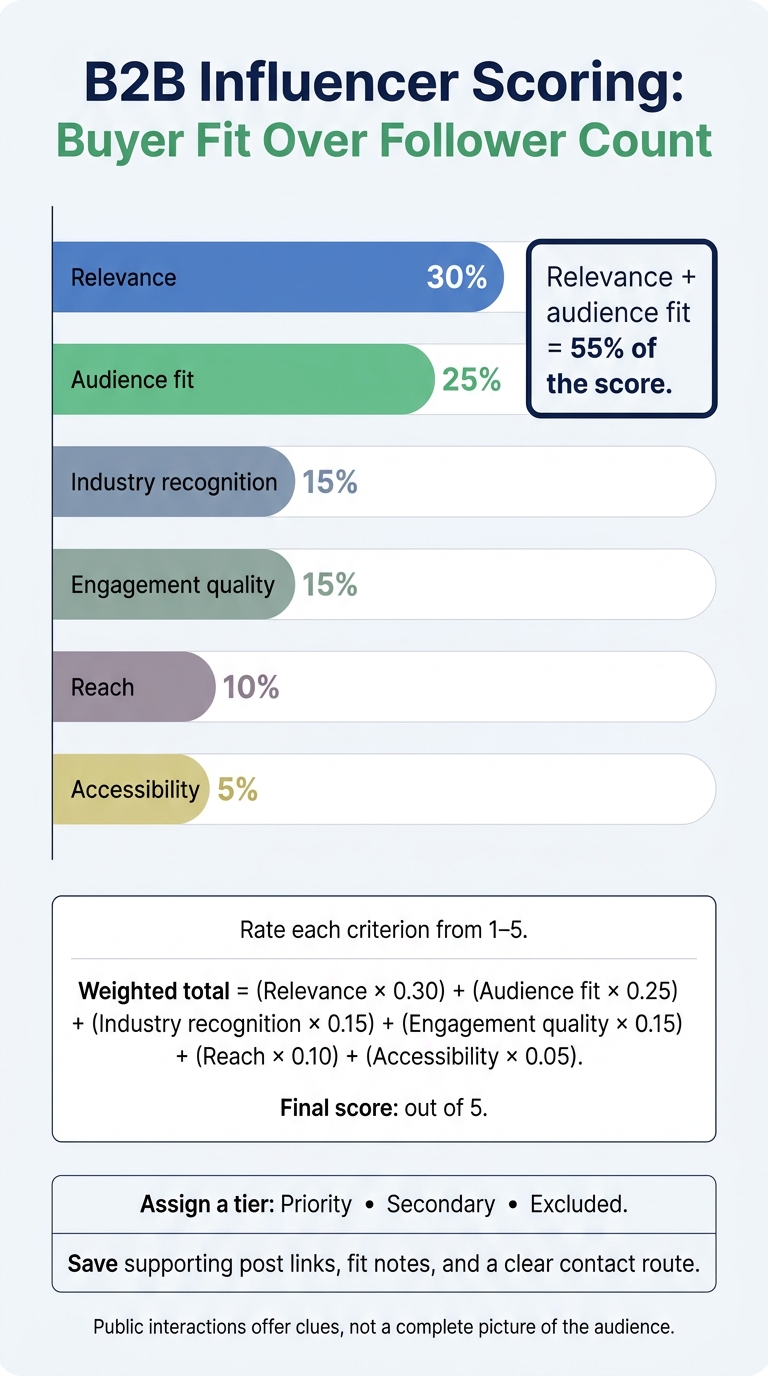
Rate each candidate from 1–5 on relevance (30%), audience fit (25%), industry recognition (15%), engagement quality (15%), reach (10%), and accessibility (5%). Calculate the weighted total out of 5, then assign each candidate to the priority, secondary, or excluded tier.[4]
Start outreach with priority candidates whose records include supporting evidence and a clear contact route.
3. Build Relationships and Start Outreach
Once you’ve ranked the shortlist, build a connection with the strongest fits before proposing a partnership.
Join Relevant Conversations
Use your priority list to start conversations with accounts most likely to reach your buyers. Read their X posts and related newsletters, or listen to their podcasts. Add a useful observation, note which topics matter most to them, or give a considered response to a contrarian take.
Record these interactions so teammates can pick up the conversation. After a few useful exchanges, send a direct collaboration request.
Send a Clear Collaboration Request
Use their listed contact method. Reference a specific post or shared buyer problem, then spell out the deliverable, value for the audience, timing, effort, and compensation, if applicable. Give them a clear next step. Skip vague check-ins and repeated follow-ups.[5]
Send outreach midweek, since Monday inboxes are crowded.[5] For paid endorsements or those involving another material connection, use clear and conspicuous disclosures consistent with FTC guidance before publishing.[5]
Before sending, confirm that the account is still active and fits your goals.
Recheck Candidates and Update Records
Check fit before first contact and again before launch to avoid spending time on stale accounts. Remove inactive, unverifiable, or poorly aligned accounts from the active shortlist and X Lists. Keep the reason in your CRM, but preserve the relationship history.
Record the stage, last contact, last review date, key exchanges, and status changes. Log declines and contact preferences so teammates don’t restart unwanted outreach.
Conclusion: Keep Your Influencer Shortlist Current
Use buyer fit to guide every shortlist update. Keep your outreach tied to current buyer demand, not a fixed set of names. Use your research to keep only active, relevant accounts, and check fit before reaching out.[1][2]
Keep buyer roles, pain points, fit notes, contact routes, and relationship history in one shortlist. Update priorities as fit changes.[1][2][5] Measure progress through buyer-relevant replies and buyer-level conversations, not follower growth. Use each round of responses to refine who you contact next and how you approach them.[1][2][3]
FAQs
How can I verify an influencer’s audience demographics?
Follower count alone isn’t enough. Review replies from the past 30 to 90 days. Check the job titles, seniority, and industries of the people engaging, then compare those details and the topics discussed with your ideal customer profile (ICP).
Ask the influencer for screenshots of platform analytics, or use vetting tools to flag suspicious engagement and confirm the audience’s job-title and industry mix.
How much should I budget for a B2B influencer partnership?
Budget depends on the scope of work and the influencer’s reach, not just follower count. Micro-influencers with 5,000-30,000 followers typically charge $500-$2,000 per post [1]. On Instagram, micro-influencer partnerships often cost $2,000-$10,000, while broader macro-influencer campaigns can run up to $10,000 per post [2].
You can pay through flat fees, performance-based commissions, or a hybrid of the two [2].
How do I attribute leads to influencer campaigns on X?
Before launching influencer campaigns on X, give each influencer a separate set of UTM parameters and a dedicated landing page. Connect campaign results to your CRM so you can trace each contact back to the creator who brought them in.
Track the full path from first click to closed deal. Measure lead and pipeline influence, not just engagement.