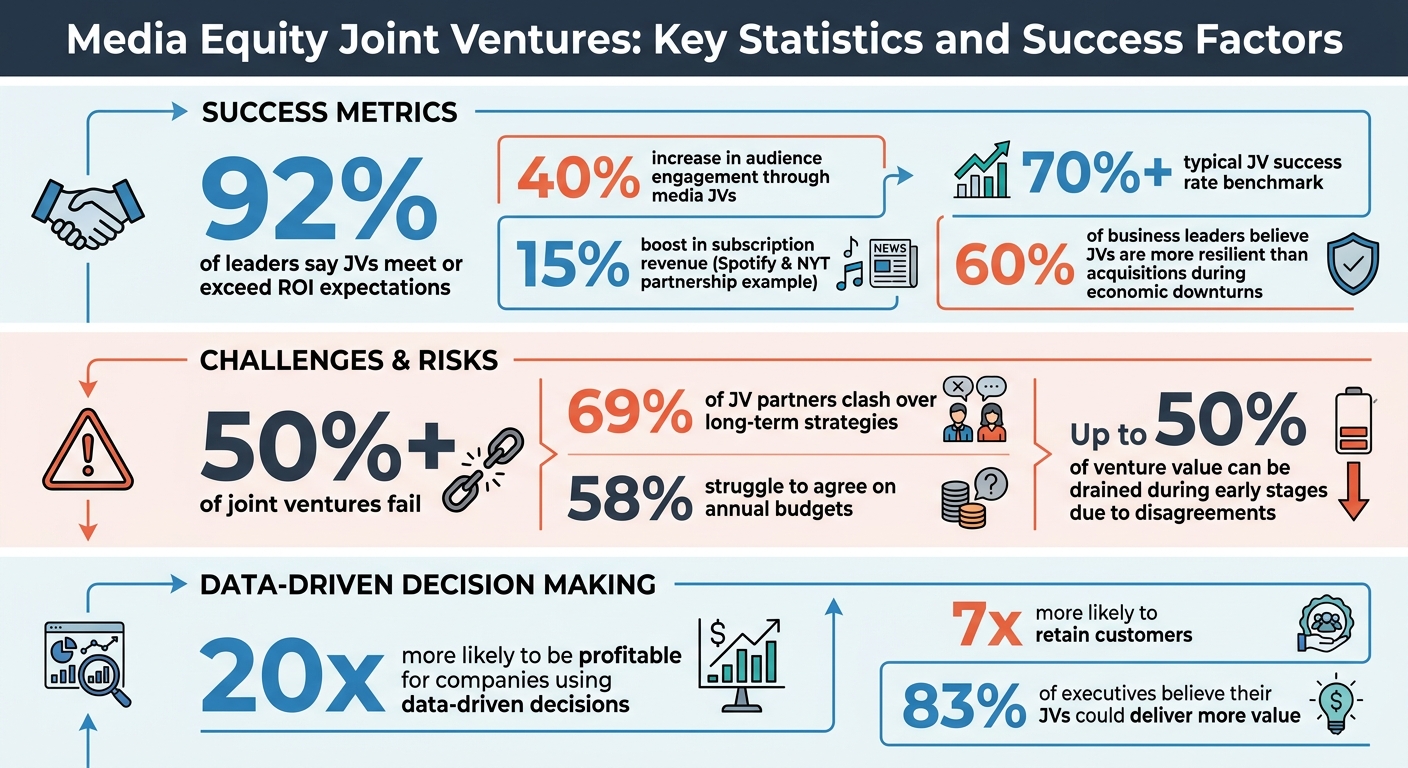
Media equity joint ventures (JVs) are partnerships where companies combine resources - like technology, capital, or market access - to create a shared entity. These ventures differ from traditional collaborations by involving shared ownership, governance, and financial commitments. For instance, Spotify and The New York Times partnered in 2026 to integrate audio content, boosting subscription revenue by 15%.
Here’s what you need to know:
- Why JVs Work: 92% of leaders say JVs meet or exceed ROI, according to B2B growth strategies. Media JVs can increase audience engagement by 40%.
- Key Trends: AI tools, blockchain, and multi-platform strategies are reshaping how JVs operate.
- Structuring Tips: Clear roles, IP agreements, and legal frameworks (LLCs or C-Corps) are essential.
- Governance: Define decision-making authority and use tools like RACI frameworks for smoother operations.
- Risk Management: Plan for disputes, financial risks, and exit strategies upfront.
JVs allow companies to test markets, reduce risks compared to mergers, and leverage shared strengths. But success depends on careful planning, partner alignment, and ongoing performance tracking.
Media Equity Joint Ventures: Key Statistics and Success Factors
Planning and Structuring a Media Equity Joint Venture
Evaluating Potential Partners
Finding the right partner can make or break a joint venture. Financial stability is a major factor - partners with strong cash flow, manageable debt, and a solid reputation in their industry are more likely to succeed. But numbers aren’t everything. Compatibility in management style and organizational culture is just as important. For instance, pairing a micromanager with a hands-off leader could create bottlenecks in decision-making. A great example of addressing this is the 2003 BMW-Brilliance Auto Group partnership, which created a "third culture" by appointing culture champions and establishing clear RACI frameworks.
"The best JV partners are those that share the same target audience as you but are not direct competitors." – Colin MB Cooper, Investor and Business Growth Expert
It’s also smart to look for complementary strengths. Partners should bring different but compatible expertise to the table. For media ventures, audience alignment and engagement quality matter more than just having a large follower count. Before finalizing a partnership, hosting a pre-mortem workshop can help uncover potential roadblocks - like funding disagreements, strategic shifts, or clashing product plans - and allow you to address these risks in the agreement.
By carefully evaluating potential partners, you’ll be better prepared to define clear roles and responsibilities.
Defining Scope, Contributions, and Ownership
While a 50:50 equity split might seem like the fair choice, it can lead to gridlock when decisions need to be made. Take Verizon and Hearst’s 2016 partnership, for example. Their joint venture, Verizon Hearst Media Partners, operated with an equal split, but their success came from clearly defining decision-making authority. Verizon brought technology, ad sales, and distribution, while Hearst contributed digital content and production expertise.
Intellectual property (IP) is another critical area to address. Categorize IP into three types: Contributed (transferred to the venture), Licensed (retained but with usage restrictions), and Foreground (created during operations). Research shows that joint ventures with clear IP governance protocols are more resilient.
Instead of insisting on equal decision-making power, consider a "Sphere of Control" model. Assign authority based on expertise - one partner might handle technical development while the other oversees marketing and sales. Goodyear and Sumitomo Rubber Industries used a similar approach by creating "Twin JVs", with each partner holding a majority stake in different regions, allowing for smoother operations.
Lastly, explicitly define reserved matters - those high-stakes decisions that require special approval. For example, decisions involving large debts, budget approvals, or CEO changes could require a supermajority vote to protect minority interests and prevent unilateral actions.
Once roles and contributions are set, the next step is selecting the right legal framework.
Selecting a Legal Structure
For domestic media joint ventures, Limited Liability Companies (LLCs) are often the go-to choice. They offer pass-through tax benefits and flexible governance options. For instance, you could structure an LLC so that a 30% owner has 50% of the voting rights if outlined in the operating agreement.
C-Corporations, on the other hand, might be better for partners who need accounting consolidation (typically requiring an 80% vote and value), plan to go public, or need to comply with foreign tax treaties. However, C-Corps come with tradeoffs like double taxation and more rigid formalities. Another consideration: LLC operating agreements remain private, while corporate charters and bylaws are public, which could be a factor if confidentiality is important.
| Feature | Contractual JV | Equity JV (LLC/Corp) |
|---|---|---|
| Liability | No shield; joint/several liability | Limited liability for parent companies |
| Setup Cost | Lower; fast to establish | Higher; complex legal/tax setup |
| Financing | Harder to raise external capital | Easier; entity can hold collateral |
| Best For | Short-term projects/co-marketing | Long-term strategic alliances |
For shorter collaborations, like a six-month co-branded content series, a contractual joint venture might suffice. These are governed by agreements that outline cost/revenue sharing and decision-making rules, but they don’t offer the liability protection of equity structures.
"A joint venture is an ongoing legal relationship, not a transaction with a defined closing." – Alex Lubyansky, Esq.
Don’t skip over deadlock resolution mechanisms in the agreement. Common strategies include "Russian Roulette", where one partner sets a price and the other decides to buy or sell at that price, and "Texas Shootout", which uses sealed bids to determine the acquiring party. While these clauses can be tough to negotiate, they’re essential, given that more than 50% of joint ventures fail.
sbb-itb-01010c0
Managing and Scaling a Media Equity Joint Venture
Setting Up Governance and Decision-Making
Getting governance right from the start is critical for smooth operations. Most media joint ventures (JVs) follow one of three management structures: a Management Committee model with equal representation from partners, a CEO/Manager model where a single leader has operational authority, or a Hybrid model that combines a CEO for daily operations with a Board for strategic oversight.
Leaving governance details vague can spell disaster. M&A attorney Alex Lubyansky puts it plainly:
"Governance failures in JVs almost always trace back to provisions that were left vague at formation".
To avoid this, clearly outline "reserved matters" in the operating agreement. This includes defining "ordinary" versus "extraordinary" decisions and setting dollar thresholds for approvals. For instance, management might handle routine expenses like a $5,000 content production cost, but larger commitments - say, a $100,000 distribution deal - should require partner sign-off. Examples of decisions needing supermajority or unanimous consent include budget approvals over $50,000, changes to capital structure, or hiring and firing key executives.
A RACI (Responsible, Accountable, Consulted, and Informed) framework can also help clarify decision-making roles. BMW Brilliance used this approach in its partnership with China's Brilliance Auto Group, appointing "culture champions" from both sides to avoid deadlocks common in 50/50 splits.
Transparency is another cornerstone of good governance. Include provisions for monthly financial updates, quarterly management reports, and annual audited statements to keep both partners informed. Additionally, require prior disclosure and recusal for related-party transactions - like when a JV buys services from a parent company - to avoid conflicts of interest.
Once governance is solid, turning to digital tools can help scale operations efficiently.
Using AI and Digital Tools for Growth
With governance in place, technology becomes the next lever for growth. Modern Partner Relationship Management (PRM) tools integrated with platforms like Salesforce or HubSpot eliminate manual data handling and provide a centralized "single source of truth." Workflow automation can also notify teams in real time when leads are registered or deals move forward.
For media ventures, AI can play a pivotal role in audience analysis, helping assess whether a new vertical aligns with your target market before making big investments.
The B2B Ecosystem offers tools like QuantAIfy's AI suite to streamline operations. For example:
- AI Process Optimizer: Modernizes workflows in content production or distribution.
- TAM Analyst: Delivers detailed market insights for expansion planning.
- GTM Brain: Provides go-to-market strategies and short-term business plans, ideal for launching new content series or partnerships.
To track performance, automate metrics using real-time scorecards for stakeholders. Key performance indicators (KPIs) like partner-sourced revenue, win rates, and deal velocity can be monitored continuously, avoiding the delays of quarterly reviews. Regularly auditing partner analytics also helps identify top-performing distribution channels, allowing you to focus resources where they’ll have the most impact.
Media attribution remains an evolving area, particularly for television. As Sheena Amin, Director at ITV Adventures, notes:
"TV specifically is somewhat opaque and a kind of black box type of advertising medium... there's still a lot to be done [in education]".
Measuring Performance
With governance and tech-driven growth strategies in place, measuring performance becomes the next priority. Success in media equity JVs hinges on tracking the right metrics. Financial health can be assessed through net profit margin, revenue growth, and ROI, while audience engagement requires monitoring website traffic, social media interactions, click-through rates (CTR), time on page, and conversion rates. A strong JV success rate - typically 70% or higher - is a key benchmark.
For digital platforms, metrics like a bounce rate below 40% and an average session duration of 2–3 minutes indicate healthy user engagement.
As the venture matures, shift focus from rapid scaling to disciplined revenue growth. The "Rule of 40" is a popular benchmark: your revenue growth rate and profit margin should add up to at least 40%. Metrics like Net Retention Rate (NRR) and Annual Contract Value (ACV) ensure you’re not just acquiring new customers but also retaining and growing relationships with existing ones.
| Growth Stage | Primary Focus | Key KPIs to Track |
|---|---|---|
| Early Growth | Market Traction | CAC, LTV:CAC Ratio, Burn Rate, NPS |
| Scaling Up | Retention & Expansion | Net Retention Rate (NRR), ACV, EBITDA less CapEx |
| Maturity | Stability & Exit Readiness | Gross Margin, Net Dollar Retention (NDR), Rule of 40 |
Set SMART KPIs - Specific, Measurable, Attainable, Realistic, and Time-bound - to ensure clarity and accountability. As Vipul Shah, Co-founder and CFO of FinQore, emphasizes:
"When businesses operate with exit-ready data every day... they make decisions more proactively, grow revenue more profitably and increase valuation more predictably".
Instead of waiting for annual reviews, conduct quarterly performance assessments. Companies that rely on data-driven decisions are nearly 20 times more likely to be profitable and 7 times more likely to retain customers. With 83% of executives believing their JVs could deliver more value, regular performance reviews and adjustments can be the difference between success and failure.
Managing Challenges and Risks in Media Equity Joint Ventures
Resolving Disputes Between Partners
Joint ventures often stumble not due to a lack of trust but because of an over-reliance on 50/50 equity splits. Equal control can lead to a deadlock when decisions are needed most. Research shows that 69% of JV partners clash over long-term strategies, and 58% struggle to agree on annual budgets. These disagreements can drain up to 50% of a venture's value during its critical early stages.
To avoid this, it's smart to build structural imbalance into the agreement from the start. Instead of splitting control evenly, assign specific decision-making authority to each partner. For instance, one partner might oversee content production while the other handles distribution. A great example of this is BMW Brilliance, which created a "third culture" by appointing representatives from both BMW and China's Brilliance Auto Group. They also implemented a RACI framework to clarify decision-making roles.
When conflicts arise, having pre-agreed deadlock resolution mechanisms can save both time and money. Options include:
- Russian Roulette: One partner offers to buy out the other at a set price, and the other can either accept or reverse the deal.
- Texas Shootout: Both partners submit sealed bids, and the highest bidder buys out the other.
- Appraised Buy-Sell: An independent appraiser determines the fair market value of the venture.
As commercial dispute resolution lawyer Divyesh Popat points out:
"The potential for conflict is particularly high where there is no written agreement in place setting out the ground rules under which the joint venture will operate, or where there is a poorly drafted (or DIY) agreement lacking in important detail".
Another proactive step is conducting a "pre-mortem" workshop. This exercise helps identify potential failure points and ensures the operating agreement includes safeguards to address them.
Reducing Financial and Market Risks
Beyond resolving disputes, managing financial and market risks is essential for protecting the venture's stability. Media joint ventures often carry significant financial exposure. Structuring the venture as an LLC or Corporation can shield the parent companies from liabilities tied to the JV. Considering that failure rates for JVs often exceed 50%, risk mitigation is non-negotiable.
A phased commitment strategy can be an effective way to reduce exposure. Instead of diving into a full-scale equity JV, partners can start with lower-risk agreements like licensing or distribution deals to test the waters. For instance, L'Oréal, Hotel Shilla, and Anchor Equity Partners took this approach when launching Shihyo, a luxury cosmetics brand targeting North Asia. They minimized market risk by deeply localizing their offering, using 24 regionally inspired ingredients and leveraging established local distribution networks.
Your operating agreement should also include "reserved matters" that require unanimous or supermajority consent for major financial decisions, such as taking on significant debt, approving the annual budget, or issuing new equity. When valuing in-kind contributions like intellectual property or media assets, use a three-method valuation framework - the Cost Method, Market Method, and Income Method - to ensure both partners agree on a fair market value.
Planning for Exit Scenarios
Even with the best planning, priorities can shift, making a well-defined exit strategy crucial. Establishing clear exit triggers and valuation mechanisms before the venture launches can prevent messy disputes later. Common exit options include buyouts (where one partner purchases the other's stake), IPOs, or dissolving the venture and dividing its assets. For buyouts, partners should decide upfront whether to rely on independent appraisals or predetermined formulas like revenue multiples.
Including provisions such as a right of first refusal - giving the remaining partner the first chance to buy an exiting partner's stake - and tag-along clauses to protect minority interests can make the exit process smoother. By agreeing on these mechanisms early, partners can ensure that future changes in strategy won't derail the venture.
Conclusion and Key Takeaways
Summary of Best Practices
Creating a thriving media equity joint venture starts with getting the essentials right from the outset. Begin with strategy before diving into structure - ensure there’s a solid business rationale and strategic alignment before drafting legal agreements. Instead of opting for equal ownership splits, consider a "Sphere of Control" model that delegates decision-making based on expertise. Pair this with a clear RACI framework to minimize friction and confusion.
When it comes to intellectual property, be meticulous. Clearly separate Contributed IP (transferred to the JV), Licensed IP (retained by the parent companies), and Foreground IP (created within the JV). This approach helps avoid the risk of unintentionally creating a competitor down the road.
To anticipate challenges, conduct a "pre-mortem" workshop to identify potential deadlock scenarios and build safeguards into your operating agreement. It’s worth noting that 60% of business leaders believe JVs are more resilient than acquisitions during economic downturns.
How The B2B Ecosystem Can Help
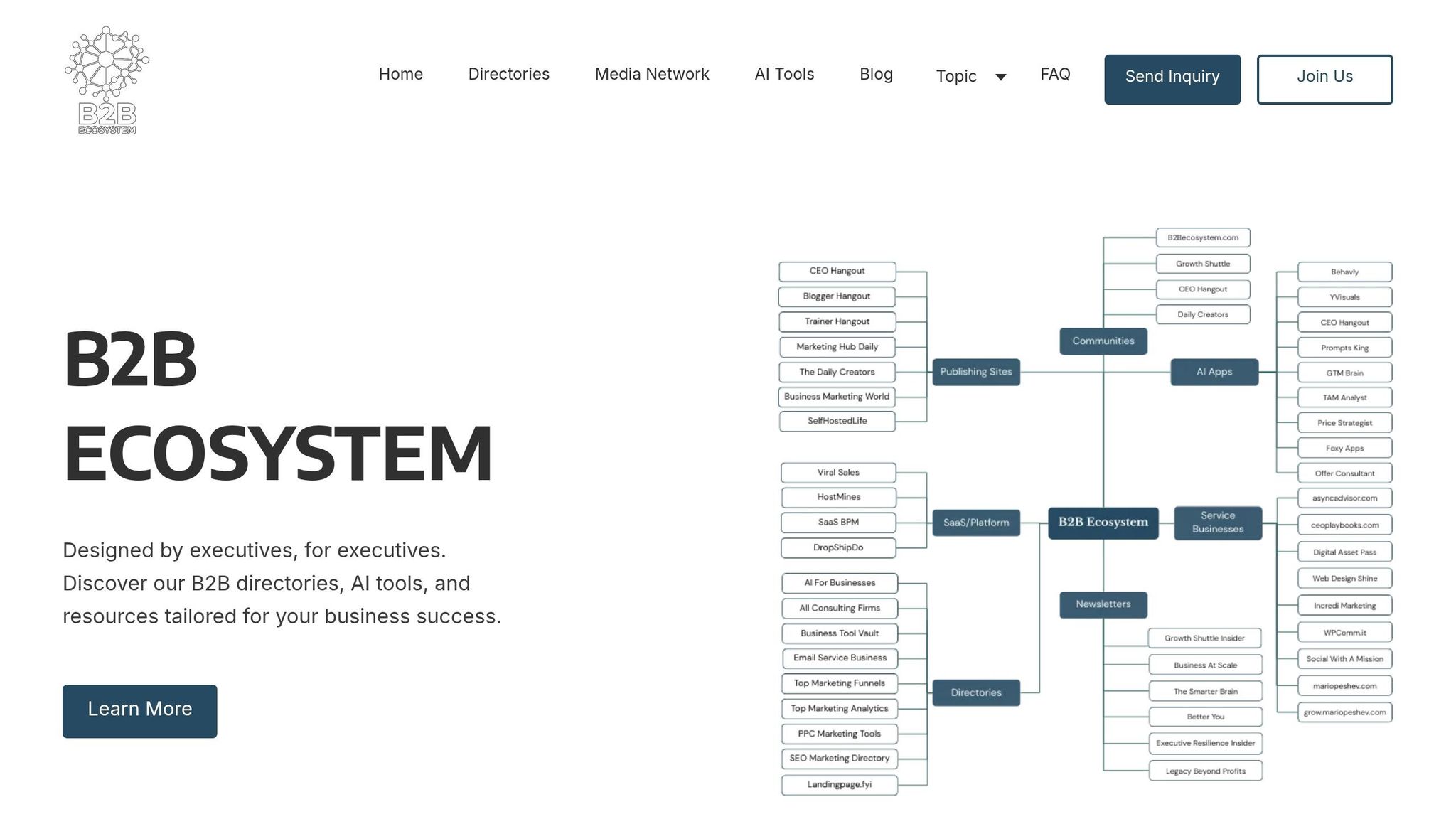
Beyond these practices, having the right support system can make a significant difference. The B2B Ecosystem offers resources to help businesses navigate the complexities of media equity joint ventures. Our directories allow you to research and evaluate potential partners, focusing on cultural alignment - a key factor, as cultural mismatches are a common reason for JV failures.
Our consulting services can guide you in structuring your venture, steering you away from risky equal splits and toward models that enhance decision-making. Additionally, tools like GTM Brain, Price Strategist, and Risk Analyzer streamline operations, refine pricing strategies, and manage risk. These AI-driven solutions also automate reporting and optimize content distribution, ensuring you have the data you need to evaluate performance effectively.
Next Steps
With these strategies and tools in hand, start by defining your business rationale and selecting partners with compatible operational styles. Test this compatibility through phased agreements before committing to full equity. When drafting your operating agreement, include clear governance structures, detailed IP guidelines, and pre-agreed exit mechanisms like buy-sell triggers or valuation formulas.
If you already have a joint venture, take a close look at your governance model and decision-making processes. If you’re facing strategic gridlock, consider restructuring authority using the Sphere of Control model. Introduce 90-day performance reviews with specific KPIs to ensure alignment and accountability. And don’t underestimate the importance of leadership chemistry - cultural fit often matters more than even the most detailed legal terms.
To explore tools, directories, and consulting services that can help you build and scale a successful media equity joint venture, visit The B2B Ecosystem.
Finding Good Joint Venture Partners - By the Strategic Advisor Board | Video 3 of 8

FAQs
How do I choose the right JV partner without creating a future competitor?
When choosing a partner, look for one whose objectives and operations align with yours while reducing any overlap. Structuring the partnership with asymmetric equity arrangements can help avoid conflicts, and it’s crucial to clearly define who holds decision-making authority to prevent deadlocks and competition.
A well-drafted joint venture agreement is essential - it should spell out each party's roles, responsibilities, and how disputes will be handled. Take the time to thoroughly vet potential partners to ensure a shared vision for the long term. Additionally, setting up governance structures can help establish clear boundaries and reduce the risk of rivalry down the line.
What should my JV operating agreement include to prevent 50/50 deadlock?
To prevent a 50/50 deadlock in a joint venture, it's crucial to outline clear decision-making processes in the operating agreement. Options like supermajority or threshold-based voting, reserved matters, and predefined conflict resolution procedures can make a big difference. These tools help assign authority, avoid stalemates, and manage disputes effectively. For instance, buy-sell provisions can be triggered if a deadlock continues, offering a structured way to resolve the impasse.
When should a media equity JV be an LLC vs. a C-Corp?
When deciding whether to form an LLC or a C-Corp for a media equity joint venture, your choice should align with your specific goals.
An LLC offers benefits like flexibility in management, pass-through taxation (avoiding double taxation), and simpler regulatory requirements. These features make it a good fit for ventures that prioritize operational flexibility and straightforward compliance.
On the other hand, a C-Corp is often the preferred option for businesses aiming to raise significant capital, attract investors, or prepare for an eventual public offering. Its ability to issue stock and its corporate taxation structure make it appealing for those looking to scale and bring in outside funding.
To make the best decision, consult with legal and tax professionals who can tailor advice to your venture’s unique objectives and needs.