Choose positioning by brand and region, not by how the company is organized. Use regional positioning when local needs change why customers buy, global positioning when one promise works across markets, and hybrid positioning when both local fit and shared costs matter.
The decision comes down to customer demand, local brand trust, cross-border recognition, cost savings, legal requirements, and team capacity.
Quick Comparison
| Model | Brand promise | Main upside | Main risk | Decision rights |
|---|---|---|---|---|
| Regional | Varies by market | Stronger local fit | Duplicate spending and brand overlap | Regional teams lead within portfolio limits |
| Global | Stays consistent across markets | Shared assets and recognition | Poor local fit or slow approvals | Global teams set standards |
| Hybrid | Fixed core with selected local changes | Local fit with shared resources | Disputes over permitted changes | Global rules, local execution |
Before rollout, define each brand’s role, assign decision owners, and test whether added gross profit exceeds launch, localization, and governance costs. Track retention and sales lost by other portfolio brands, then review pilots after 90 or 180 days.
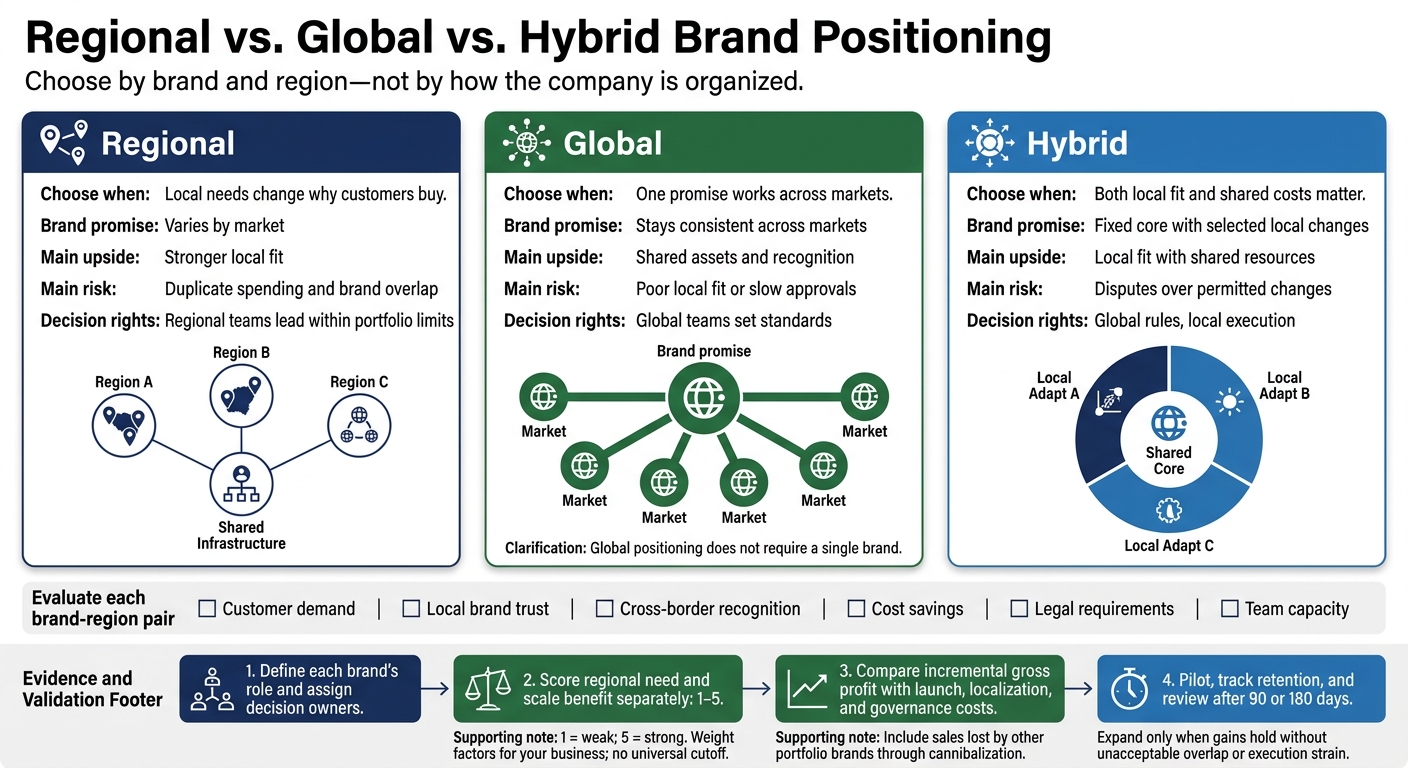
Regional vs. Global vs. Hybrid Brand Positioning
From Global to Local: How to stay true to your brand
sbb-itb-01010c0
Regional Positioning
Regional positioning fits brands whose markets differ enough that one shared promise would hurt performance. For a portfolio, it can support keeping acquired local brands when moving to the parent name would cost trust, access, or distribution.
Use this model only when local differences change buying behavior or market economics enough to affect results.
When to Choose Regional Positioning
Choose separate positions when market differences change why customers buy. Compare customer needs, language, local customs, buying occasions, decision-makers, sales cycles, service expectations, regulations, distribution structures, price sensitivity, and competitors.
Check brand maturity, too. An established regional name may hold trust that an unfamiliar parent lacks. Language changes alone, though, don't justify separate positioning.
Measure trust through awareness, consideration, repeat purchases, referrals, local search demand, and willingness to pay. Use customer interviews and win-loss analysis to link local preferences to purchases. Keep a name when replacing it could hurt relationships or revenue - not simply because the local team prefers it.
Hypothetical example: A holding company acquires service providers in Texas, Ontario, and the United Kingdom. It keeps each name because referrals and relationships drive purchases, standardizes cybersecurity, reporting, procurement, and CRM workflows, and reviews retention, referrals, margin, and acquisition costs after 12 months before deciding whether to expand, endorse, or retire each brand.
Regional Positioning: Pros and Cons
Regional positioning can make a brand more relevant to local needs, language, regulations, and customs. Regional teams can also respond faster, adjusting offers, campaigns, and service policies without waiting for global approval.
The added revenue and retention must justify the added cost. Compare those gains with spending on research, campaign development, technology, training, compliance, and governance.
| Dimension | Benefit | Risk | Implementation requirement |
|---|---|---|---|
| Customer relevance | Addresses local needs, language, customs, and trust signals | Different experiences may confuse customers who operate across regions | Define the non-negotiable brand promise and permitted local changes |
| Flexibility | Allows faster changes to offers, pricing, channels, and service | Regional teams may create conflicting messages or commitments | Give regional leaders decision rights within clear limits |
| Operating cost | Can improve results where local relevance increases conversion or retention | Duplicates research, design, content, technology, and compliance work | Share platforms, data, procurement, and reusable assets |
| Governance | Keeps decisions close to market conditions | Creates disputes over ownership, budgets, and priorities | Establish portfolio councils, escalation rules, and decision rights |
| Local competition | A regional brand may have stronger trust, relationships, referrals, and knowledge of local competitors | Regional brands may be too narrow to compete with larger global or national players | Invest in local strengths that set the brand apart while sharing scale advantages such as data, technology, and procurement |
| Portfolio coordination | Multiple brands can cover different customer segments, price points, or market conditions | Brand overlap, cannibalization, and fragmented positioning can reduce total portfolio value | Assign each brand a defined role, audience, territory, promise, and growth objective |
If local gains are small, test whether one global position can scale more efficiently.
Global Positioning
Global positioning is the simpler fit when local differences do not change buying behavior. It works when markets can share one promise without reducing conversion, trust, or speed. It does not require a single brand. Each brand can keep its name and target segment while adjusting language, pricing, distribution, and product features for local markets.[3][6]
When to Choose Global Positioning
Choose global positioning when customers share needs, buying criteria, and use cases - and the same competitive advantage matters across borders. It also suits multinational buyers who value a familiar brand and a consistent supplier or service promise. Test whether customers buy for the same benefit, not just whether they recognize the logo.[5][3]
Build the business case for scale savings; do not assume them. Estimate avoided spending on research, brand development, advertising production, packaging systems, and product development. Then subtract translation, local testing, legal review, market adjustments, and governance costs. A shared campaign saves money only if markets can reuse it.[7][8]
Global Positioning: Pros and Cons
Global positioning makes repeatable work easier, but it can spread mistakes too. Weigh portfolio-wide recognition and scale against local relevance and response times. Shared reporting should flag weak markets rather than bury them in portfolio averages.[4][5]
| Benefit | Risk | Implementation requirement |
|---|---|---|
| Consistent recognition | A common position may feel irrelevant in some markets | Test the core promise with local customers before rollout |
| Reusable brand and campaign assets | Translation, imagery, or symbols may create unintended meanings | Use qualified local reviewers to check language, local context, and legal requirements |
| Common measurement | Global metrics may hide important local differences | Combine shared KPIs with market-specific diagnostics |
| Repeatable launches | Central approvals can delay local responses | Set approval deadlines and a clear exception path |
| Shared skills and scale savings | Local adjustments and rework may erase savings | Pilot reuse and compare total costs with the existing approach |
| Portfolio coordination | Blurred roles can increase overlap; visible portfolio ties can spread reputational damage | Protect distinct brand promises and establish crisis protocols |
Governance sets the boundaries: which elements stay global, and which local teams can change.
Governance for Regional, Global, and Hybrid Models
Governance should enforce the chosen positioning model. Regional models put market decisions with regional teams. Global models centralize standards. Hybrid models set core rules centrally and leave execution to local teams.[10][14][15]
These rules keep local execution from weakening the chosen positioning or its balance between local relevance and scale. The matrix below shows who owns decisions, what needs approval, and which resources teams share.
| Governance decision | Regional model | Global model | Hybrid model |
|---|---|---|---|
| Decision ownership | Regional leaders own positioning, pricing, messaging, and market entry | Global leadership owns architecture, positioning, pricing principles, and entry standards | Global leadership owns architecture and guardrails; regional teams own local changes and execution |
| Permitted local variation | Broad variation in names, offers, claims, channels, and design and copy within legal and portfolio limits | Limited variation for language, legal requirements, channel execution, and local customs | Local changes to examples, language, media mix, promotions, and selected offers within guardrails |
| Approval thresholds | Regional approval for most decisions; corporate review for reputational, legal, or portfolio risks | Central approval for identity, value proposition, naming, claims, and major market entry | Preapproved changes proceed locally; changes to core positioning or architecture, high spending, or material risk require central approval |
| Shared assets | Teams may choose whether to use shared technology, research, procurement, and analytics | Central teams provide required brand systems, asset libraries, platforms, research, and measurement standards | Platforms, templates, data, procurement, and research are centralized; customer-facing content is localized |
| Escalation procedures | Regional leaders resolve conflicts; cross-market issues go to the holding company | A named global owner resolves disputes and records exceptions | Regional leaders resolve local escalations; decisions beyond their authority go to a global owner |
Start by giving each brand a clear job in the portfolio.
Assign Brand Roles and Decision Rights
Define each brand’s role - premium, value, specialist, challenger, regional champion, or endorser. Specify its segment, territory, offer range, price tier, and channel focus. Set rules for overlap, including account ownership, lead routing, product boundaries, and entry into another brand’s market.[9][13]
Give each decision one owner and set approval thresholds. Central review is required for any new name, material change to the brand promise, entry into another brand’s protected segment, or investment above a preset U.S. dollar threshold.[10][11][12]
Then align shared systems and performance metrics with those decision rights.
Share Resources and Measure Results
Use shared definitions to measure acquisition cost, conversion, retention, margin, lifetime value, awareness, share of voice, price realization, and cross-sell. Break results down by market maturity, customer segment, product mix, sales motion, and channel mix. Track cannibalization alongside incremental revenue.[9][13]
Report financial results in U.S. dollars on a consistent exchange-rate basis so currency movements aren't mistaken for operating performance.[9][13]
Choose Positioning by Brand and Region
Apply the governance rules above to each brand-region pair, balancing local relevance against scale. Use the matrix below to choose a model, then record the brand role, expected benefit, main risk, investment, and decision owner.
| Evaluation factor | Favors regional positioning | Favors global positioning | Possible hybrid response | Evidence required |
|---|---|---|---|---|
| Market differences | Differences in needs, occasions, or competition change buying behavior | Shared buying criteria support one promise | Keep the core promise; adjust benefits, messages, or channels | Customer interviews, segmentation, usage data, competitor analysis |
| Local brand equity | A local brand has stronger trust or distribution | The global brand has greater credibility | Keep the local name with a global endorsement or transition plan | Awareness, consideration, preference, trust, and sales data |
| Cross-border recognition | Global recognition does not influence purchases | Global recognition supports purchases | Use a global master brand with local proof points | Awareness, search behavior, customer interviews |
| Scale potential | Localization gains exceed shared-cost savings | Reusing assets and infrastructure delivers large savings | Share infrastructure; localize customer-facing elements | Asset inventory, cost-to-serve analysis, reuse rates, projected ROI |
| Regulatory constraints | Law requires material local differences in offers or claims | One position meets requirements across markets | Set global standards with required country exceptions | Legal review, regulatory mapping, claim substantiation |
| Execution capacity | Regional teams can fund and deliver separate positioning | Central teams can deliver a shared position; local capacity is insufficient | Provide central toolkits, training, and approval workflows | Staffing, budgets, decision rights, launch timelines, governance audit |
Score Market Differences and Scale Savings
Score regional need and scale benefit separately from 1-5: 1 means weak; 5 means strong. Regional need measures the need for localization. Scale benefit measures the opportunity to reuse global assets. Weight the factors for the business rather than applying a universal cutoff, and support each score with customer research, brand studies, cost data, and market performance.
Compare incremental gross profit with localization, governance, media, technology, and launch costs under base, upside, and downside cases. Include sales lost by other portfolio brands through cannibalization, not just gains for the tested brand. Use the scores to choose a regional, global, or hybrid path.
Define Global Standards and Local Exceptions
For a hybrid model, document what stays fixed: the target segment, core promise, and proof points. Also specify which changes to language, channels, and local benefits are allowed.
Each exception request should state the customer need or legal requirement, expected return, cost, approval authority, and review date. Reject changes that duplicate another portfolio brand’s role, and review approved exceptions annually. Use the exception log to guide testing before rollout.
Test Changes Before Expanding
Before testing the chosen path and exceptions, confirm customer research, brand architecture, decision rights, localization capacity, and baseline performance. Test selected brand-region combinations against comparable markets, segments, or channels. Compare incremental gross profit, localization spending, time to launch, customer demand, and execution burden - not conversion alone. Track retention and longer-term value, too.[16]
Set execution, mid-test, and profitability review dates before launch. Record pricing, distribution, seasonality, competitor activity, and media changes so their effects aren't mistaken for positioning gains. Agree on escalation triggers for declines in profit, consideration, compliance, or delivery speed.
Expand only when gains hold without unacceptable overlap or execution strain. Revise when customer demand improves but costs are too high or capacity is insufficient. Reverse when commercial or brand damage persists.
Conclusion: Balance Market Needs and Portfolio Costs
Choose the model that delivers more value after governance costs: local relevance or scale economics. Use a governed hybrid when both matter.
Global brands can tailor execution to local markets while keeping the core promise. Regional brands can centralize research, technology, and procurement while keeping their market fit. Even a centralized model can adjust where demand differs.
Electrolux centralized personalization across 21 markets and 6 languages, adapting products, offers, currencies, images, and recommendations to local demand; the program was associated with a 16% increase in direct-to-consumer revenue.[17]
Use the scorecard to select pilot markets, assign owners, and schedule a 90- or 180-day review before rolling out across the portfolio.
FAQs
How can we rebrand without losing local customer trust?
Keep your brand consistent globally while giving regional teams room to adjust. Maintain core brand values, messaging, and visual identity, but let local teams tailor tone, imagery, and communication styles to local norms and expectations [1][2].
Use a modular campaign framework to separate fixed brand elements from those regions can change. Draw on local research and expert input, and track shifts in local customs and attitudes so your rebrand stays true to the brand and responds to changing expectations [1][2].
How can we separate positioning gains from market growth?
Track brand positioning KPIs alongside market growth in standardized brand scorecards. Review them monthly for brand health and quarterly for portfolio performance [1][2].
Compare each brand’s revenue growth and market share changes against overall market growth and portfolio averages. Then compare customer acquisition cost with customer lifetime value (CLV) to help check whether gains come from winning demand, not just market growth [2][1].
When should we consolidate overlapping regional brands?
Consolidate overlapping regional brands when a brand audit shows they serve the same customer segments, sell similar products, or compete for the same demand. That overlap can confuse customers and waste resources. Inconsistent messaging and visuals across touchpoints are also signs that consolidation may be due.
Keep brands separate when each has a distinct value proposition and a clear market role, such as serving different price tiers or niches. Track performance regularly to confirm those differences still hold.