Choose an audience data platform by testing 1 business use case, not comparing feature lists. Confirm that it can use approved data, connect to existing tools, and meet privacy requirements. Then compare verified results and the full 3-year cost, including internal labor.
The process has 3 steps:
- Define the need: Set a measurable goal, check data quality and permissions, and decide whether a CDP, DMP, clean room, composable stack, or existing tool fits.
- Test vendors: Apply required pass-or-fail checks, score finalists, and run the same proof of concept.
- Plan the rollout: Put data rights, service levels, and exit terms in the contract. Assign owners, launch 1 workflow, and track results and costs.
A high score cannot make up for a failed requirement.
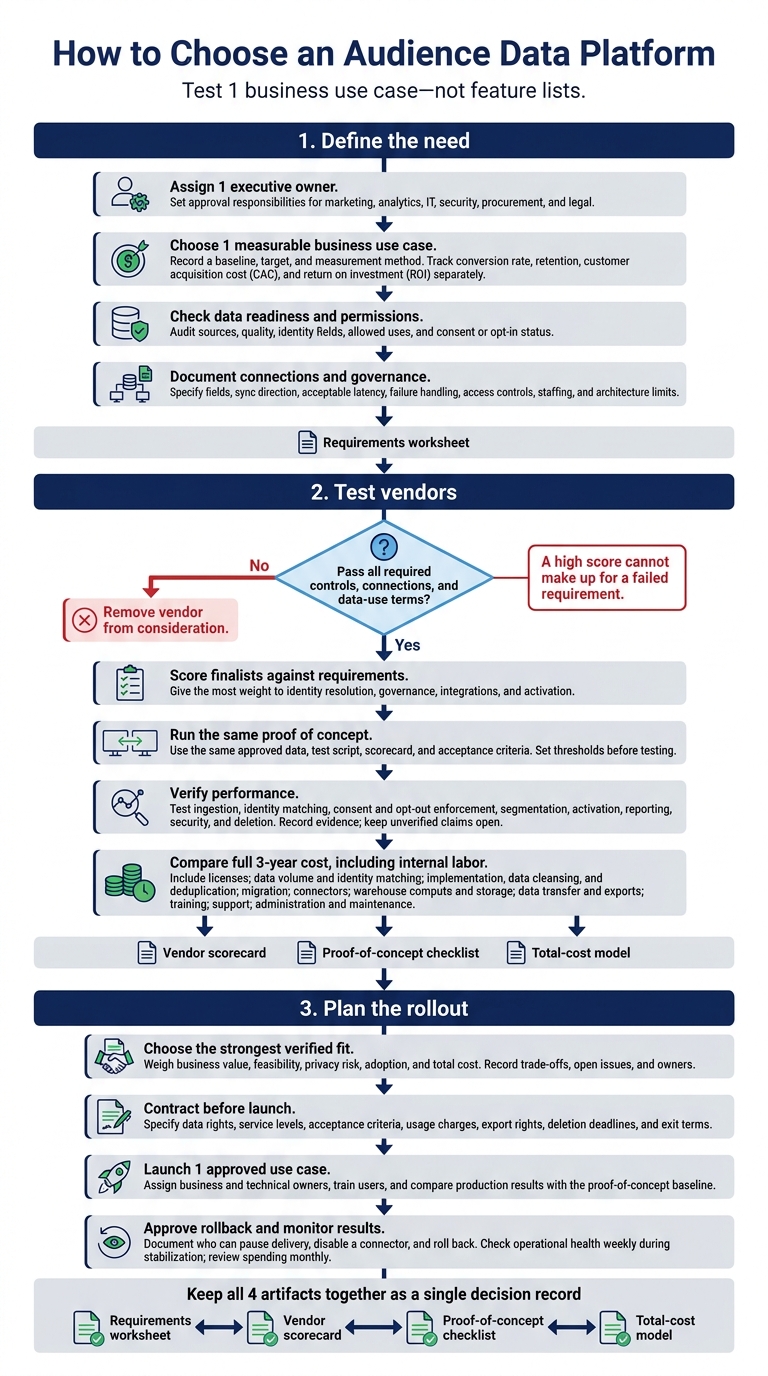
How to Choose an Audience Data Platform
How to Choose the Right Customer Data Platform (CDP): Everything You Need To Know
sbb-itb-01010c0
Step 1: Define Your Needs and Check Data Readiness
Once you know the platform type, turn your business goal into a requirements list.
Assign 1 executive owner before contacting vendors. Bring in marketing and analytics to define outcomes, IT to assess integrations and staffing, security to set controls, procurement to review costs, and legal to confirm approved data use. Give each team a clear approval responsibility.
Choose Priority Use Cases and Set Success Measures
Pick the workflows most closely tied to conversion and customer loyalty. For each, record a baseline, target, and measurement method. Use historical performance to establish what normal looks like.
Track conversion rate, retention, customer acquisition cost (CAC), and return on investment (ROI) separately. This lets you compare platforms on business impact, not just how fast they build audiences. Then map each goal to the data needed to support it.
List Data Sources and Required Connections
Audit your CRM, website, email, event, and approved partner data sources. Record their quality, volume, update frequency, identity fields, geographic coverage, allowed uses, and consent or opt-in status. Flag missing identifiers and unclear permissions before counting records as usable.
Document required APIs, SDKs, warehouse connections, reverse ETL workflows, exports, and destinations. Check the fields and how connections work, not just vendor logos. Specify sync direction, acceptable latency, error alerts, retries, and who handles failures. Require real-time updates only when the workflow needs them.
Next, define the governance rules that determine whether the setup can be used.
Set Governance and Architecture Requirements
Create 1 requirements worksheet that links each workflow to its sources, connections, owner, outcome, staffing needs, and architecture limits.
Have legal review privacy and compliance requirements, data-use limits, and any sharing across brands or business units. Document who owns enriched datasets and which access controls are needed to protect them.
Step 2: Score Vendors and Test Finalists
Build a Weighted Vendor Scorecard
Build the scorecard from the Step 1 requirements worksheet. Give the most weight to identity resolution, governance, integrations, and activation.
Apply pass-or-fail gates before scoring optional features. Remove any vendor that fails a required control, connection, or data-use term.
| Criterion | Required evidence | Measured result | Risk |
|---|---|---|---|
| Identity resolution | Labeled match results; person-to-account rules | Measured result | False merges |
| Identity match quality | Sample record checks at export | Measured result | Bad contact data or bounce risk |
| Governance and compliance | Permission, suppression, and deletion tests; consent processing | Measured result | Data use without permission |
| Integration and portability | Tested field mappings; export of profiles, IDs, and audience definitions | Measured result | Custom maintenance or lock-in |
| Activation latency | Confirmed delivery to required destinations; latency logs | Measured result | Delayed signals |
| Cost and staffing | Itemized 3-year pricing; setup hours; internal owner estimates | Measured result | Hidden usage fees and labor |
Compare total cost and setup effort only after vendors pass the must-have gates.
Compare Total Costs and Setup Effort
Request a 3-year cost worksheet that includes internal labor. Use quoted U.S. dollar amounts in every field and consistent annual growth assumptions across the model.
| Cost worksheet item | Year 1 | Year 2 | Year 3 |
|---|---|---|---|
| Platform licenses | $ input | $ input | $ input |
| Data volume and identity matching | $ input | $ input | $ input |
| Implementation, data cleansing, and deduplication | $ input | $ input | $ input |
| Migration | $ input | $ input | $ input |
| Connectors | $ input | $ input | $ input |
| Warehouse compute and storage | $ input | $ input | $ input |
| Data transfer and exports | $ input | $ input | $ input |
| Training | $ input | $ input | $ input |
| Support | $ input | $ input | $ input |
| Administration and maintenance | $ input | $ input | $ input |
| Annual total | $ total | $ total | $ total |
Compare architectures by who will do the work. Composable platforms can use an existing warehouse, but someone still needs to own integration and day-to-day data management.[2] Using the Step 1 worksheet, require each finalist to estimate setup hours, customer responsibilities, internal ownership, and the date its first workflow can pass acceptance testing.
| Approach | Staffing to budget | Setup dependencies | Time-to-value check | Cost drivers | Lock-in risks to inspect |
|---|---|---|---|---|---|
| Packaged | Administrator; integration support | Vendor data model and connectors | Date first built-in workflow passes | License, profiles, add-ons | Proprietary profiles and rules |
| Hybrid | Administrator; data engineer | Warehouse-to-platform synchronization | Date both systems reconcile | Platform plus warehouse usage | Duplicated logic and copies |
| Composable | Data engineer; analytics and operations owners | Warehouse models and activation connections | Date an end-to-end workflow passes | Compute, storage, connectors, labor | Tool-specific models and APIs |
Keep testing limited to the workflows, sources, and controls defined in Step 1.
Test Finalists With the Same Proof of Concept
Set acceptance criteria using the Step 1 use cases, sources, and governance rules. Send every finalist the same scorecard, pricing worksheet, test script, and acceptance criteria. Provide the same approved, minimized company data or representative test data.
Test ingestion, identity matching, consent and opt-out enforcement, segmentation, activation, reporting, security, and deletion. Set thresholds before testing. For identity, check match rate, false matches, and missed matches against labeled records. In B2B, assess person matching and account matching separately.[2]
Record results in the comparison sheet below. Measure end-to-end latency from the source event to its destination, and have your own users complete the workflow. Keep unverified claims listed as open items.
| Test or disclosure | Finalist A | Finalist B | Finalist C |
|---|---|---|---|
| Ingestion completeness; end-to-end latency | Measured result + logs | Measured result + logs | Measured result + logs |
| Match rate; false and missed matches | Measured result | Measured result | Measured result |
| Consent, opt-out, security, and deletion | Pass/fail + evidence | Pass/fail + evidence | Pass/fail + evidence |
| Segmentation, activation, and reporting | Measured result + reconciliation | Measured result + reconciliation | Measured result + reconciliation |
| User task completion; implementation duties | Time + owner | Time + owner | Time + owner |
| Integration reliability and recovery behavior | Measured behavior + logs | Measured behavior + logs | Measured behavior + logs |
| Exit export and deletion procedures | Tested/documented | Tested/documented | Tested/documented |
| Unverified claims | Open items | Open items | Open items |
Rank finalists using verified test performance, not sales claims.
Step 3: Choose the Platform and Plan the Rollout
Move the proof-of-concept winner from evaluation to contracting.
Choose the platform with the strongest verified fit across business value, feasibility, privacy risk, adoption, and total cost. Write a short decision memo that connects requirements to proof-of-concept results and records trade-offs, open issues, and owners. Get approval from business, IT, security, and privacy stakeholders, then finalize commercial and data terms before launch.
Negotiate Data Rights, Service Levels, and Exit Terms
Put commitments in the contract. Specify implementation milestones, acceptance criteria, security responsibilities, permitted vendor data uses, uptime, support response times, and remedies for missed commitments.
Define billable usage, overage rates, renewal increases, and spending alerts. Favor modular commitments when demand is uncertain. Document ownership of your data, rights to derived audiences, export formats and fees, deletion deadlines, and termination assistance.
Have counsel confirm the data-processing terms and consent requirements for each intended use. After signing, limit the launch to 1 approved use case.
Launch One Use Case and Assign Owners
Start with 1 measurable workflow validated in the proof of concept, using approved sources. Assign a business owner for the outcome and technical owners for taxonomy, identity, consent, quality, access, and activation. Name an approver for each launch criterion.
Train users on the actual workflow. Compare production results with the proof-of-concept baseline before adding channels.
Make rollback part of launch approval. Document who can pause audience delivery, disable a connector, and roll back the launch. Keep access and data volume unchanged until blockers are closed.
Track Results, Costs, and Platform Fit
Set the review schedule before launch. Check operational health weekly during stabilization and review spending monthly.
After launch, track the outcome metric, adoption, data quality, privacy incidents, and spending. Tie each measure to the selected use case to check whether the platform delivers the expected outcome. Reassess platform fit when channels, data rights, legal rules, or business needs change.
Conclusion: Choose Based on Verified Requirements
Make the final call using one set of evidence. Use the requirements worksheet to connect each business goal to data readiness and governance requirements. Weight those requirements in the vendor scorecard, then apply the same proof-of-concept checklist to every finalist. Compare evidence, not sales pitches.
Check that the total-cost model covers software, implementation, usage, and maintenance. Keep all 4 artifacts together as a single decision record.
Required capabilities are pass-or-fail gates. A high score cannot offset a failed requirement. Start rollout only after assigning owners and measurable acceptance criteria.
FAQs
Do I need a CDP, DMP, or clean room?
The right choice depends on what you need your data to do:
- A CDP brings first-party data together into persistent customer profiles for long-term account mapping and cross-channel activation.
- A DMP focuses mainly on anonymous third-party data for ad targeting. It doesn't maintain persistent customer records.
- A clean room lets teams collaborate on data securely while meeting privacy requirements.
If disconnected systems and data silos limit your targeting, reporting, or campaign performance, a CDP may help.
How much data is enough for a reliable pilot?
There’s no universal minimum sample size. How much data you need depends on your hypothesis and target level of statistical confidence.
Choose a test duration that accounts for relevant business variables. Collect data consistently, and flag anomalies or biases. Use Bayesian inference or A/B/n testing to assess statistical reliability.
For data strategy support, The B2B Ecosystem offers advisory services to help connect operational metrics to financial outcomes.
How can I isolate the platform’s impact on ROI?
Measure incremental gross profit, not clicks or attributed revenue. Use holdout groups to compare results with and without the platform’s influence. Randomize by account so buying groups stay together [1].
Calculate the platform’s payback period using this formula [1]:
Payback period (months) = Total implementation and maintenance costs ÷ (Monthly incremental gross profit - Monthly operating costs)