Contract automation is saving companies time, money, and reducing risks. Businesses that adopt Contract Lifecycle Management (CLM) platforms are transforming contracts into active financial tools. Key benefits include:
- Revenue Protection: Companies lose 8-9% of annual revenue due to missed renewals and untracked obligations. Automation recovers 2-5% of contract value.
- Time Savings: Manual tasks like contract review (45-60 minutes) drop to 5-8 minutes with automation. Contract cycle times shrink by 40-55%.
- Cost Efficiency: Businesses save on labor costs (up to $1.2M annually) and external legal fees ($233K+).
- Higher ROI: Studies show 314%-449% ROI, with payback periods under 6 months.
- Improved Compliance: Automation boosts compliance rates to over 95%, reducing errors by 85%.
AI-driven tools amplify these results, cutting manual effort, improving accuracy, and scaling ROI as contract volumes grow. Enterprises processing over 5,000 contracts annually see returns exceeding 3,500%.
Want to implement this? Start with baseline metrics, pilot 200-300 contracts, and phase your rollout over 6-12 months to maximize results.
Workday connects contract data to move faster and drive ROI with Evisort
sbb-itb-01010c0
Measured ROI from Contract Automation
Contract automation delivers measurable financial benefits in three key areas: speed, cost, and risk reduction. By turning contracts into active financial tools, companies can see noticeable improvements, often within the first year of adoption.
Faster Contract Lifecycles and Workflow Efficiency
Automating contracts can cut cycle times by 40–55%. Processes that used to take 19 days can now be completed in just 3 days - an impressive 84% improvement. AI-driven tools also reduce legal review time by 50–70%.
A financial services COO shared:
"We are about 20% faster at establishing new partnerships due to our investment in Docusign CLM."
This speed not only accelerates deal closures but also reduces the resources required, creating a ripple effect of efficiency throughout the organization.
Cost Savings and Resource Optimization
Switching from manual processes to centralized automation cuts administrative costs by an average of 24%. Legal teams see a 44% boost in productivity, allowing them to focus on strategic tasks instead of routine ones. Additionally, external legal fees drop significantly, with companies saving an average of $233,000 annually.
Proactive contract management recovers 2–5% of contract value that might otherwise be lost due to missed renewals, uncollected penalties, or untracked price adjustments. For every dollar spent on contract management software, businesses recover between $91 and $183 in revenue. For instance, in April 2025, Yates Construction saved $15,000 monthly in administrative costs after rolling out Concord's automation software across 15 regional divisions, cutting contract administration expenses by 25%.
These savings go hand in hand with improved compliance and reduced risk, further strengthening the financial case for automation.
Better Compliance and Risk Management
Automation pushes compliance rates to over 95%, compared to 75–85% with manual processes. Error rates also drop significantly - Docusign CLM users reported an 85% reduction in contract errors. Research from Goldman Sachs shows that automation reduces payment errors by 75–90%. Considering that manual errors can cost $2,000–$8,000 per contract in rework, and regulatory penalties can range from $25,000 to over $100,000, these reductions are critical.
Automated alerts for key dates, like renewals and milestones, help prevent costly oversights or unfavorable auto-renewals. Legal teams no longer waste over an hour daily switching between systems to keep track of contract priorities. This streamlining minimizes missed obligations, reduces legal risks, and strengthens vendor relationships, all contributing to a healthier bottom line.
How AI Increases ROI in Contract Automation
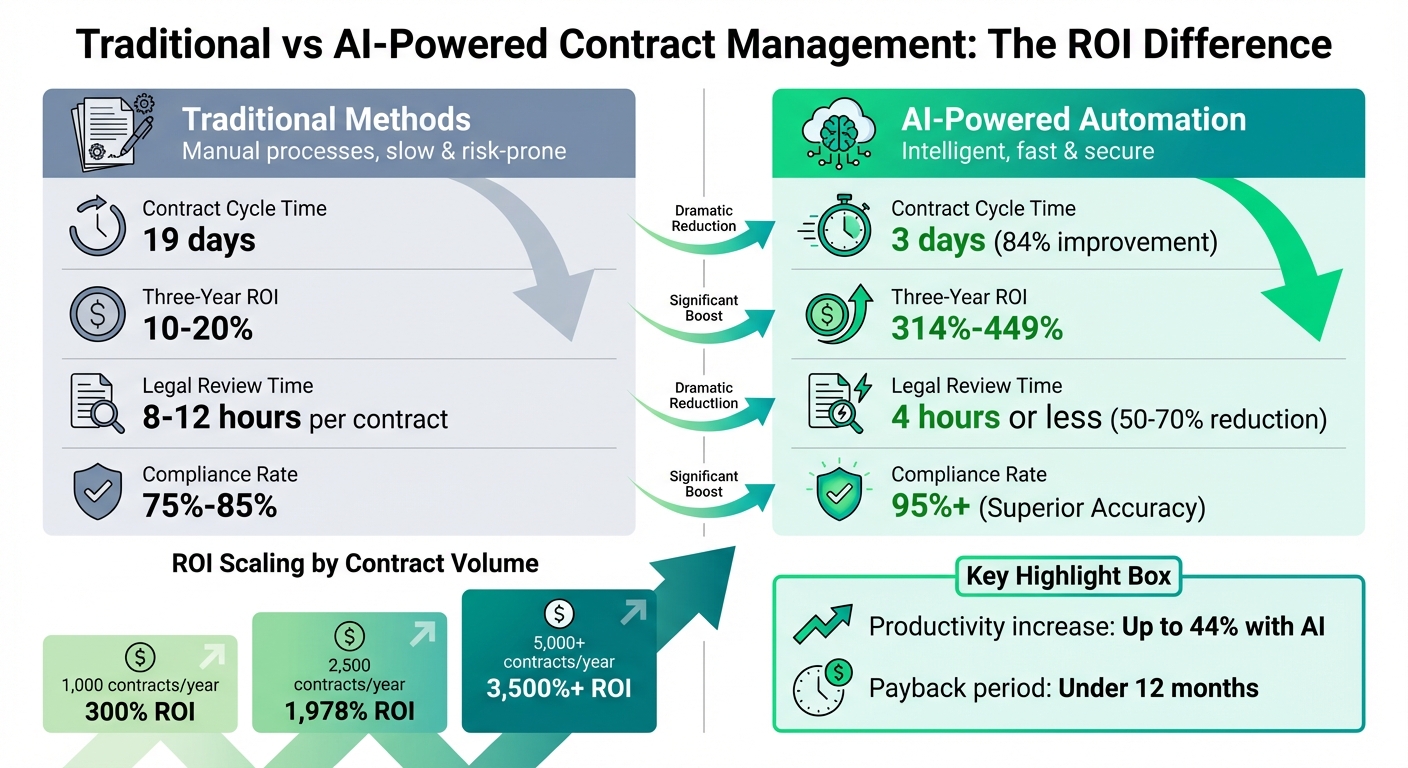
AI-Powered vs Traditional Contract Management ROI Comparison
Artificial intelligence is reshaping how businesses handle contracts, turning them into tools that not only manage risks but also uncover opportunities and recover lost revenue. These advancements lead to smarter, AI-driven processes that enhance productivity and significantly boost ROI.
AI-Driven Productivity Gains
AI-powered tools can increase productivity by up to 44%, revolutionizing legal and procurement workflows. By achieving 80% to 90% accuracy in metadata and field extraction, AI eliminates repetitive tasks, freeing up skilled professionals to focus on higher-value activities. For example, Docusign CLM customers reported cutting the time to generate a new sales contract by 90%. This means teams can spend less time assembling documents and more time on strategic negotiations.
Higher ROI with AI vs. Traditional Methods
The financial benefits of AI in contract management are striking when compared to traditional approaches. Traditional methods typically yield a 10-20% ROI, whereas AI-powered CLM systems often deliver first-year ROI exceeding 300%.
| Metric | Traditional Methods | AI-Powered Automation |
|---|---|---|
| Contract Cycle Time | 19 days | 3 days |
| Three-Year ROI | 10-20% | 314%-449% |
| Legal Review Time | 8-12 hours per contract | 4 hours or less |
| Compliance Rate | 75%-85% | 95%+ |
The ROI from AI grows dramatically with contract volume. For example, companies handling 1,000 contracts annually achieve 300% ROI. However, for organizations processing 2,500 contracts, this ROI jumps to 1,978%, and businesses managing 5,000+ contracts see returns exceeding 3,500%. This exponential scaling occurs because AI's cost per contract remains minimal, while manual processes require proportional increases in staffing.
First-Year ROI and Long-Term Value
AI delivers immediate results by shortening payback periods from 18 months to less than 12 months. The first-year benefits stem from time savings and reduced errors, but the long-term advantages lie in revenue protection and smarter decision-making.
AI tools actively monitor contract obligations, flag renewal dates, and enforce price adjustments. For every dollar spent on AI-driven contract management, businesses recover between $91 and $183 in revenue. Over time, this proactive revenue capture turns contracts into dynamic financial assets, helping organizations protect and grow their earnings year after year.
Case Studies: Financial and Operational Results
Real-world examples highlight how these ROI metrics translate into measurable financial and operational benefits.
Value Recovery and Cost Reductions
Thomson Reuters reported a 110% ROI by automating contracts, which helped slash outside counsel expenses by $233,000. Similarly, a company managing a $500 million contract portfolio lowered revenue leakage from 7% to 2%, recovering $25 million annually. These savings were achieved by addressing missed renewals, improving obligation tracking, and enforcing price escalations that had previously been overlooked.
These financial wins are complemented by substantial time and resource savings, making operations smoother and more efficient.
Reclaiming Time and Resources
Automation also delivers significant time and resource savings. For example, a global pharmaceutical company streamlined its agreement process, reducing contract signing times from weeks to just 15 minutes. By sending over 300,000 digital envelopes annually and saving $25 per envelope, this company saved $7.5 million each year.
In another case, a travel organization used automation to free up half of a four-person legal team. The Head of Global Legal Operations noted:
"We've seen a huge productivity boost. We've freed up half of a four-person team - just due to technology".
A composite organization leveraging Ironclad reported $1.2 million in labor cost savings and an additional $1.2 million in reduced outside legal spending over three years, resulting in a 314% ROI. These time and cost savings empower teams to shift their focus from administrative tasks to more strategic, high-value initiatives.
How to Implement Contract Automation
Setting Measurable KPIs for Success
Start by documenting key baseline metrics like contract cycle times, administrative costs, compliance rates, and revenue leakage before rolling out automation. This data provides a solid foundation to measure your return on investment (ROI) effectively.
Use a balanced scorecard to track critical areas such as operational speed, cost savings, compliance improvements, and stakeholder satisfaction. Industry benchmarks suggest aiming for a 40–55% reduction in contract cycle times and a 30–50% cut in legal review costs.
Leverage AI-powered data extraction tools to automate data capture and feed real-time updates into your KPI dashboards. Establish benchmarks for contract complexity, such as 2–5 days for simple agreements, 5–10 days for standard ones, and 15–30 days for more complex contracts. Additionally, target at least 95% accuracy in clause extraction to ensure precision.
Implementation Timelines and Optimization Strategies
Once your KPIs are clearly defined, structure your implementation in phases to meet these goals progressively. Plan for a 6–12 month rollout divided into three stages:
- Phase 1 (Months 1–3): Set up the contract repository, migrate your data, configure workflows, and train an initial group of users.
- Phase 2 (Months 4–8): Activate AI for data extraction, automate approval processes, and integrate the platform with existing systems.
- Phase 3 (Months 9–12): Introduce advanced features like conversational AI and predictive analytics, while refining workflows based on performance data.
Kick things off with a pilot program involving 200–300 contracts from a single business unit. This approach helps validate your ROI assumptions and builds confidence across the organization. Focus first on straightforward, high-impact contract types to demonstrate quick wins.
To avoid value leakage, set up automated alerts for key events like renewal dates, price adjustments, and milestone-based payments. Integrate your contract lifecycle management platform with existing systems to eliminate data silos and reduce manual data entry.
Conduct monthly performance reviews using dashboard insights and gather user feedback to quickly address any bottlenecks. Secure executive sponsorship and provide tailored training for different roles to overcome resistance to change. These actions will help translate your KPIs into tangible ROI improvements, reinforcing the financial advantages of contract automation.
Conclusion
Key Takeaways and Next Steps
Contract automation doesn’t just speed things up - it delivers measurable financial advantages. To recap, companies adopting modern CLM platforms have reported impressive three-year ROIs and quick payback periods . These tools turn contracts into dynamic assets that safeguard revenue, minimize risks, and free up resources for more strategic initiatives.
Operationally, the benefits are just as striking. Organizations have seen 40–55% reductions in contract cycle times, 50–70% lower legal review costs, and the recovery of 2–5% of annual contract value that would otherwise be lost to leakage . Additionally, AI-powered automation cuts manual errors by 85% and boosts compliance to over 95% - a game-changer for businesses navigating today’s complex regulatory landscape .
Beyond the numbers, contract automation completely redefines legal and procurement workflows. Industry leaders have noted significant productivity gains, enabling their teams to shift focus from tedious administrative tasks to high-impact strategic work.
If you’re ready to take the first step, start by documenting your baseline metrics, running a pilot with 200–300 contracts to test ROI assumptions, and ensuring executive buy-in . This phased approach not only validates the technology’s value but also aligns it with your broader business goals.
The case for contract automation is clear. With the technology now mature and capable of delivering results quickly, there’s no better time to act and secure both immediate benefits and a stronger competitive edge.
FAQs
What KPIs should we track to prove CLM ROI?
To figure out the ROI of Contract Lifecycle Management (CLM), it’s all about tracking the right KPIs that show both financial and operational improvements. Some of the key metrics to keep an eye on include contract error rates, cycle times, compliance rates, renewal rates, and legal spend. These numbers tell a clear story about cost savings, reduced risks, and streamlined processes.
For instance, quicker approval times and fewer mistakes can lead to noticeable cost reductions. At the same time, better compliance and meeting contractual obligations point to stronger strategic value and smoother operations. These metrics make it easier to see the tangible benefits CLM brings to the table.
How many contracts are needed for a reliable pilot?
When determining how many contracts to analyze, it depends on your specific goals and circumstances. A practical starting point is around 50 to 100 contracts. This range provides enough data to identify trends and assess ROI or process improvements while keeping the workload manageable. It strikes a balance between gathering useful insights and avoiding resource strain.
What integrations are most important for enterprise rollout?
To make enterprise contract automation truly effective, it’s essential to connect it with the tools and systems your team already relies on. Key integrations include contract lifecycle management (CLM) systems, as well as tools for document review, e-signatures, and data analysis. These integrations ensure workflows remain seamless and allow you to get the most out of your investment by building on processes and technologies your team is already familiar with.