I would test demand, costs, and legal access before funding a global media launch. My starting point: use 4 frameworks in sequence, then test the plan with a 90-day pilot and a $10,000-$30,000 spending cap.
Each framework answers a different question:
- PESTLE: What outside risks could block entry?
- CAGE: What must change to serve the target audience, and what will that cost?
- Market Attractiveness and Entry Options: Is demand worth pursuing, and which entry route fits the budget and control needs?
- Scenario Planning: Does the plan still work if acquisition costs rise or search and AI referrals fall?
Quick Comparison
| Framework | Main decision | Output |
|---|---|---|
| PESTLE | Can we enter? | Risk register |
| CAGE | What must change? | Localization and staffing estimates |
| Market Attractiveness and Entry Options | Where and how should we enter? | Ranked markets and selected entry route |
| Scenario Planning | When should we scale, revise, or exit? | Pilot decision gates |
I would set <u>pass/fail rules before spending</u>, then track acquisition cost, subscriber growth, referral share, and revenue potential. The pilot budget and timeline are proposed test limits, not industry benchmarks. A promising score is a reason to test - not approval to launch.
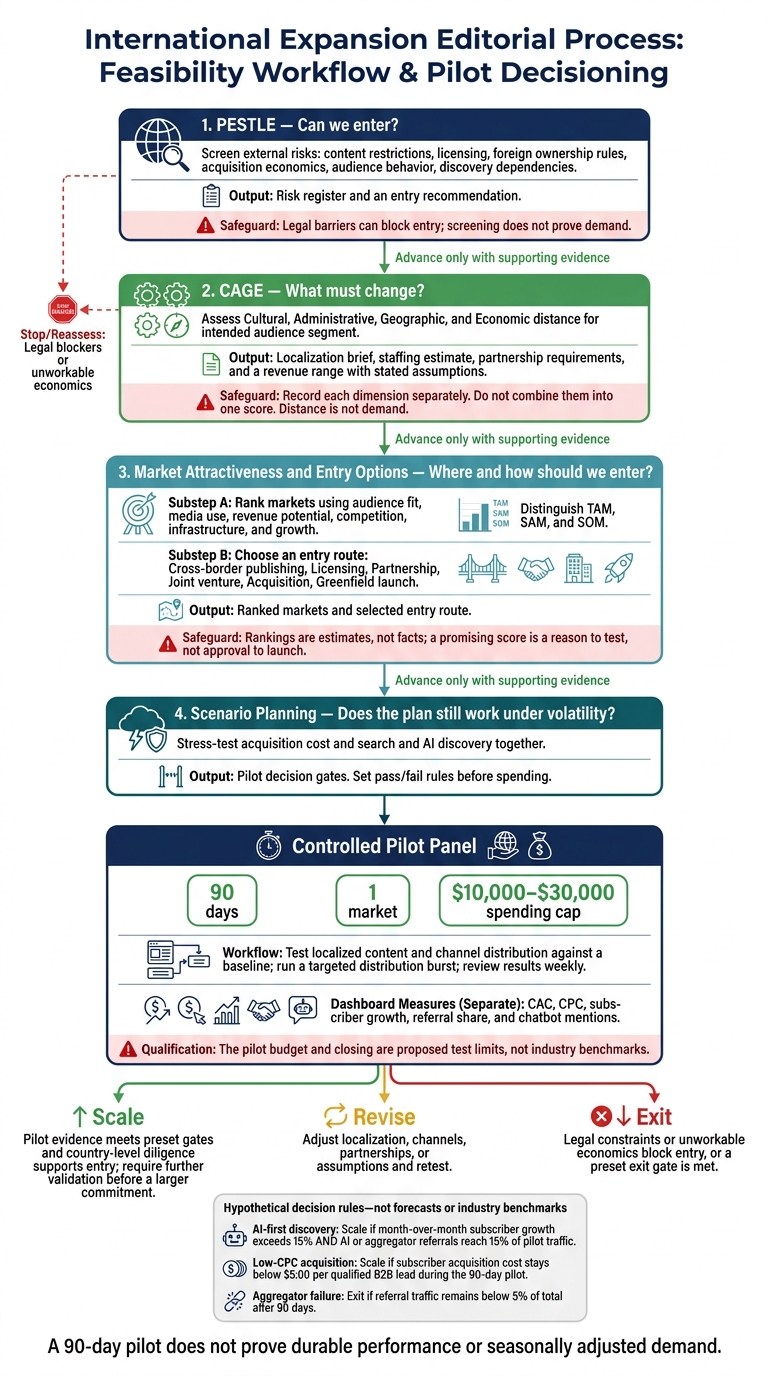
Global Media Expansion: From Risk Screening to Pilot Decisions
Global Market Entry Strategies Explained (Exporting, Licensing, Joint Ventures & FDI)
sbb-itb-01010c0
1. PESTLE Analysis
Check political and legal barriers first. Then test acquisition economics, audience behavior, and discovery dependencies. Track results weekly. [1][2]
Keep a country-level evidence log instead of relying on general impressions. Use the template below for each market. Blank risk and decision fields mean unrated and pending evidence.
| Dimension | Country | Evidence | Expansion Impact | Risk Level | Mitigation | Decision Status |
|---|---|---|---|---|---|---|
| Political / Legal | Assess content restrictions, licensing, and foreign ownership rules with expert validation [2] | Determines whether entry is permitted | Expert validation | |||
| Economic | Track CPC trends for traffic and subscriber acquisition, plus sponsorship opportunities [1] | Tests acquisition economics | Monitor CPC weekly [1] | |||
| Social | Analyze audience behavior and engagement patterns [2] | Tests audience fit and guides content tone and channel mix | Use behavior analytics tools [2] | |||
| Technological | Monitor SEO trends, algorithm updates, connectivity, and how AI chatbots source and attribute content [1] | Tests discovery stability and identifies dependencies | Run cross-platform experiments and track discovery signals [1] |
Produce a risk register and an entry recommendation. Block entry if the market has a high risk score or acquisition costs exceed lifetime value. Automated risk scoring should flag potential blockers before the final decision. [1][2]
PESTLE flags external blockers. It does not prove demand, editorial fit, or execution capacity. Move unresolved assumptions into a capped pilot, then use CAGE to measure adaptation cost.
2. CAGE Distance Framework
Use CAGE to quantify adaptation costs for each target segment. PESTLE screens for blockers; CAGE then measures what it will cost to serve a viable segment. Assess the intended audience, not just the country. A shared language does not mean shared audience habits or buying behavior.
Record each dimension separately. Do not combine them into one score.
| Distance Dimension | Measurable Indicator | Evidence | Management Implication | Limitation |
|---|---|---|---|---|
| Cultural | Audience habits and engagement by format | Platform engagement metrics and cross-platform experiments across newsletters, YouTube, and social channels | Prioritize formats, tone, and distribution that fit the target segment | High follower counts may not translate into high-intent B2B demand |
| Administrative | Regulation and compliance requirements | Official rules and local legal advice | Determine whether direct entry, a partnership, or another permitted entry mode is workable | A favorable commercial outlook cannot offset a legal barrier |
| Geographic | Infrastructure and platform reach | Connectivity tests and delivery data | Set technical requirements and market coverage assumptions | Digital metrics can miss physical connectivity gaps |
| Economic | CPC for traffic and subscriber acquisition; revenue potential | CPC trends and pilot price tests | Adjust acquisition budgets and revenue assumptions to local conditions | Low CPC does not guarantee lead quality or sustainable LTV |
Each dimension informs different decisions. Cultural distance shapes localization and hiring. Geographic distance sets coverage and technical requirements. Administrative distance guides partnerships and entry mode. Economic distance informs pricing and investment ceilings.
CAGE identifies adaptation work that country-level screening can miss and quantifies what must change to serve a segment profitably. Distance is not demand: a familiar market may still have weak sponsorship potential.
Produce a localization brief, staffing estimate, partnership requirements, and a revenue range with stated assumptions. Use these outputs in the next section to choose an entry mode.
3. Market Attractiveness and Entry Options
Score the market before choosing an entry mode. Use the localization brief and revenue range from CAGE to build the scorecard. Separate total addressable market (TAM) from reachable demand (SAM) and likely share (SOM).[2]
Use one scorecard to assess audience fit, media use, revenue potential, competition, infrastructure, and growth. Record an assumption, evidence, and confidence level for each factor. Update the scorecard with CPC, SEO, and cross-platform data.[1]
Set pass/fail rules before testing, and account for seasonal CPC volatility.[1] Use the scores to advance an opportunity, request more evidence, or reject it when the economics or legal constraints make entry unworkable.
Take the highest-scoring opportunity into the entry-mode table. These ratings are directional; local duties still need to be checked.[2]
| Entry option | Control | Speed | Capital | Regulatory exposure | Localization capability | IP protection | Reversibility |
|---|---|---|---|---|---|---|---|
| Cross-border publishing | High | High | Low | Low | Low | High | High |
| Licensing | Low | High | Low | Low | Medium | Medium | High |
| Partnership | Medium | Medium | Medium | Medium | High | Medium | Medium |
| Joint venture | Medium | Medium | High | High | High | Medium | Low |
| Acquisition | High | Medium | Very high | High | High | High | Very low |
| Greenfield launch | Very high | Low | High | High | Very high | High | Low |
When evidence is thin, run a $10,000 to $30,000 pilot campaign before committing to a larger launch.[1] Use the results to set scenario assumptions and decision gates.
4. Scenario Planning and Pilot Decision Gates
Once the market scorecard and entry mode are set, test the 2 assumptions most likely to break the launch case: acquisition cost and search and AI discovery. Track weekly CPC, SEO changes, and chatbot and aggregator mentions to check whether the selected entry mode still works.[1] Unlike PESTLE or CAGE, scenario planning tests how these assumptions change together.
Run a 90-day controlled pilot in 1 market. Test localized content and channel distribution against a baseline. Then run a targeted distribution burst to check whether the brand appears in aggregators and AI tools.[1] Treat the results as pilot gates, not forecasts.
The scenarios and thresholds below are hypothetical decision rules, not forecasts or industry benchmarks.
| Scenario | Key Assumptions | Leading Indicators | Contingency Actions | Gate Criteria |
|---|---|---|---|---|
| AI-first discovery | AI chatbots and aggregators become the primary discovery layer. | Chatbot mentions; SEO visibility in new search tools; AI/aggregator referral share. | Shift budget toward PR, directory placements, and other targeted distribution bursts. | Scale if month-over-month subscriber growth exceeds 15% and AI or aggregator referrals reach 15% of pilot traffic.[1] |
| Low-CPC acquisition | Low-CPC conditions persist. | Weekly CPC; subscriber acquisition cost; cross-platform growth. | Increase spend on the best-performing channels and keep testing localized content. | Scale if subscriber acquisition cost stays below $5.00 per qualified B2B lead during the 90-day pilot.[1] |
| Aggregator failure | Brand amplification does not produce measurable discovery. | Low referral traffic from directories and aggregators; stagnant SEO organic growth. | Revise distribution through direct influencer or podcast partnerships and retest the market. | Exit if referral traffic remains below 5% of total after 90 days.[1] |
Track CAC, subscriber growth, referral share, and chatbot mentions separately in a weekly dashboard. Use those measures to make 1 decision: scale, revise, or exit.[1] A 90-day pilot does not prove durable performance or seasonally adjusted demand.[1] Use the results to compare frameworks by how well they support the final expansion decision.
Comparing Frameworks by Expansion Decision
After testing assumptions in pilots, compare how each framework informs the expansion decision at each stage.
Prioritizing Markets
Each framework answers a different question. PESTLE screens external blockers, CAGE assesses adaptation costs, Market Attractiveness ranks entry routes, and Scenario Planning tests whether the plan holds up under volatility.
| Framework | Contribution to Expansion Decisions | Analytical Gaps |
|---|---|---|
| PESTLE Analysis | Flags external blockers, including regulatory shifts and economic conditions that affect acquisition costs. | Does not explain how to execute an entry route. |
| CAGE Distance Framework | Shows how cultural and administrative distance affects localization and partnership needs. | Does not account for technology shifts, such as AI algorithm updates or SEO volatility. |
| Market Attractiveness and Entry Options | Helps teams choose between acquisition-led and organic entry based on sponsorship and attention opportunities. | May give too little weight to pilot validation. |
| Scenario Planning and Pilot Decision Gates | Uses pilot tests and scorecards to guide investment approval before scaling. | Can be costly and may delay entry into fast-moving opportunities. |
Uncertainty and Pilot Decisions
Market Attractiveness and Entry Options guides route selection. Scenario Planning is the main tool for validating that choice before scaling.
| Framework | Uncertainty Addressed | Evidence Needed | Gate Contribution | Limitation |
|---|---|---|---|---|
| PESTLE Analysis | Regulatory, economic, currency, and infrastructure changes. | Rule changes, exchange rates, and supplier costs. | Sets legal and operating conditions that require a stop. | A static screen becomes outdated without scheduled reviews. |
| CAGE Distance Framework | Unexpected adaptation and coordination burdens. | Editorial rework, approval delays, and localization spending. | Signals when local staffing or partner support needs to change. | Does not predict audience growth or revenue shifts. |
| Market Attractiveness and Entry Options | Changes in demand, competition, monetization, and entry costs. | Revenue pipeline, retention, margins, and revised launch estimates. | Tests whether the selected market and entry route still justify investment. | Rankings depend on assumptions and scoring weights. |
| Scenario Planning and Pilot Decision Gates | Combined shifts in demand, platform dependence, revenue, and cost. | Pilot results, channel concentration, cash burn, and compliance clearance. | Connects emerging conditions to decisions to continue, adjust, pause, or exit. | Pilots may not reproduce full-scale network effects. |
Strengths and Limits of Each Framework
Separate what each framework measures from what it cannot prove. PESTLE screens external barriers; CAGE maps adaptation cost. Neither measures demand or return. [1]
Use the table to turn those limits into decision safeguards.
| Framework | Principal Strength | Principal Weakness | Best-Fit Decision | Safeguard |
|---|---|---|---|---|
| PESTLE Analysis | External risk screening | No return estimate | Whether to advance past risk screening | Use a separate return model before committing capital |
| CAGE Distance Framework | Adaptation cost mapping | No demand validation | How much localization to fund | Validate audience and sponsor demand before rejecting distant markets |
| Market Attractiveness and Entry Options | Market–entry alignment | Subjective rankings | Which opportunity to test | Recheck assumptions before selecting a pilot |
| Scenario Planning and Pilot Decision Gates | Controlled exposure | Limited validation | Which uncertainties to test | Cap pilot spending; require further evidence before scaling |
Treat rankings as estimates, not facts. Keep observed results separate from forecasts. If a small change in an assumption reverses the ranking, get more evidence rather than refine the scoring.
Test whether the ranking holds when you pay for attention. Set a $10,000–$30,000 spending ceiling for a targeted pilot campaign using featured listings, PR stories, and newsletters. [1] A paid pilot tests initial interest, not behavior at scale. Use the results to decide whether to scale, revise, or exit, and require further validation before scaling.
Conclusion: A Step-by-Step Feasibility Process
These frameworks work as a single feasibility process: use PESTLE to screen risk, CAGE to measure distance, then rank markets by demand and execution cost. Next, choose an entry mode, test scenarios, and validate assumptions with a controlled pilot. Each stage informs the next decision - it does not automatically justify moving forward.[1]
| Framework | Decision Step | Recommended Output |
|---|---|---|
| PESTLE | Screen external risk | Viable market shortlist |
| CAGE | Compare cross-border distance | Distance scorecard |
| Market Attractiveness | Rank demand and execution cost | Ranked market list |
| Entry Options | Choose an entry route | Selected entry mode |
| Scenario Planning | Test financial exposure | Risk-adjusted budget |
| Pilot Decision Gates | Validate assumptions before capital approval | Go/no-go report |
Approve expansion only when observed customer acquisition cost (CAC) and cost per click (CPC) meet preset thresholds and country-level diligence supports entry.[1][2]
Use the full process for expansion across multiple countries, heavy localization, material regulatory exposure, or large capital commitments. Use lighter PESTLE screening for early-stage research.[2]
FAQs
How do I set realistic pilot pass/fail thresholds?
Set thresholds around core business goals, not vanity metrics. Use current customer acquisition costs, churn rates, and sales revenue as benchmarks. Track performance across the funnel, and factor in your resources, budget, and risk tolerance.
Start with core features, then refine them using real-time data. Document which indicators signal success, a change in direction, or a decision to stop. Agree on expectations with stakeholders early, then monitor results and adjust your approach as market conditions change.
What if the frameworks suggest conflicting decisions?
Use frameworks as guides, not fixed plans. Match them to your business goals, risk tolerance, and stage of development. Combine elements from different models when it makes sense.
Run a maturity assessment to map your capabilities and see where frameworks point in different directions based on your resources. If conflicts remain, use scenario planning to compare possible outcomes. Weigh each path’s financial effects and impact on day-to-day operations before deciding.
How do I estimate customer lifetime value in a new market?
Estimate customer lifetime value (CLV) using a financial model that accounts for expected market share growth, market size, and required investment. Track pipeline velocity, deal size, and retention rates to refine your projections.
AI-driven tools from The B2B Ecosystem can help analyze total addressable market (TAM) and competitive dynamics. DevriX can help set up measurement frameworks to track these metrics as operations scale.