AI segmentation models are reshaping how media networks target audiences and optimize ad spend. Traditional demographic targeting is becoming less effective, with accuracy dropping by 34% since 2019. AI models, by analyzing user behavior and real-time data, deliver better results: 58% higher conversion rates and 44% lower customer acquisition costs compared to older methods. Here's a quick look at five leading platforms:
- Salesforce Einstein: Predicts user actions and integrates CRM data for real-time insights.
- Amplitude: Focuses on behavioral data and predictive cohorts to enhance engagement.
- CleverTap: Combines rule-based logic with machine learning for intent-based targeting.
- Delve AI: Generates detailed audience personas using psychographic and behavioral data.
- Locatium: Leverages real-time location intelligence for precise, geography-driven segmentation.
Each platform offers unique strengths - whether it's predictive scoring, behavioral analysis, or location-based insights - making them valuable tools for refining audience targeting in a world moving away from third-party cookies. Below, we dive into their methodologies, integrations, and use cases to help you choose the right solution for your needs.
How to Build Customer Segments with AI (Real-World Use Case)
sbb-itb-01010c0
1. Salesforce Einstein
Salesforce Einstein brings artificial intelligence directly into the daily operations of media networks by providing predictive insights within Salesforce's Sales, Marketing, and Media Clouds [8][10].
Segmentation Methodology
Einstein tracks customer behavior across various touchpoints - like website clicks, email interactions, form completions, and purchase history - to create dynamic audience profiles. Each prospect is scored on a scale from 0 to 100, with updates every four hours to reflect real-time engagement [4][5]. Unlike static demographic labels, this score acts as a live indicator of buying intent.
The platform goes a step further by predicting specific actions, such as whether a subscriber might cancel their service or upgrade to a premium tier [6]. Additionally, Einstein uses natural language processing to scan text for trending topics and keywords, helping guide content and advertising strategies [3].
By combining these advanced analytics, Einstein simplifies and centralizes data management processes.
Integration Capabilities
Einstein runs on Salesforce Data Cloud, which merges data from clickstreams, app usage, and ad interactions into a single, cohesive view [11]. This eliminates the need for manual data stitching. MuleSoft APIs further enhance its connectivity by linking it to external systems [9][11].
A practical example of this integration was seen in early 2026, when Grupo Globo, a Brazilian media powerhouse, held a two-day workshop for 70 employees. Each participant successfully built an autonomous AI agent within 48 hours, showcasing the platform's ease of use and low-code functionality [8].
"Out of all the Salesforce products we use, Agentforce was the easiest to get started with." – Samuel Dall'Agnol, Digital Director, Grupo Globo [8]
Accuracy and Performance Metrics
Einstein’s seamless data integration supports its strong performance metrics. To ensure accurate scoring, the system requires one year of historical engagement data and a minimum of 20 prospects linked to opportunities [5]. It also includes a score decay feature that lowers a prospect's ranking when engagement levels drop [5].
Between 2024 and 2025, Spotify Advertising utilized Sales Cloud Einstein to provide ad representatives with real-time dashboards and AI-driven insights. This resulted in 95% faster client data queries for campaigns and contributed to a 19% increase in advertising revenue year-over-year [7][8]. Executives also benefited from full visibility into the sales pipeline, eliminating blind spots in forecasting.
Media Network Use Cases
Einstein’s analytics and integration capabilities help media networks fine-tune their ad spending by evaluating channel performance and reallocating budgets to strategies with the highest ROI [3]. It also identifies clients at risk of churning, allowing sales teams to step in with tailored retention offers [3][4]. On the content side, Einstein suggests the best channels and timing for customer engagement, boosting click-through rates for both editorial and advertising content. Its image recognition feature further supports creative teams by analyzing visual elements to inspire data-driven storytelling [3].
2. Amplitude
Amplitude stands out by using behavioral data to predict user actions, offering a fresh take on segmentation. By analyzing past activities - like articles read, videos watched, or subscription activations - the platform groups users into cohorts and applies machine learning to predict future events, such as churn or upgrades [13].
Segmentation Methodology
Amplitude organizes users into three key types of cohorts:
- Behavioral cohorts: Groups users by specific actions, such as binge-watching a series.
- Predictive cohorts: Uses AutoML to continually update predictions about future actions, recalculating hourly.
- Computed properties: Aggregates raw data, like total hours streamed, into actionable insights [13].
Its Critical Event Identification feature helps pinpoint activities that drive engagement. For example, streaming services might find a specific viewing threshold linked to long-term retention, while news platforms could identify a reading frequency that boosts subscription conversions. By turning static experiences into dynamic, personalized ones, Amplitude Activation has been shown to increase conversions by 15% to 30% [12][13].
Integration Capabilities
Amplitude integrates seamlessly with advertising and email platforms, syncing cohort data in real time or hourly [13]. This ensures messaging remains relevant to a user’s current journey. For instance, it can trigger a "Welcome Back" email when a previously inactive subscriber re-engages. As third-party cookies become obsolete, Amplitude enables media networks to create first-party cohorts based on actual user behavior, rather than relying on outdated demographic assumptions [12].
Media Network Use Cases
Several media networks have achieved impressive results using Amplitude:
- Slate: By simulating paywall scenarios, they saw a 500% increase in conversions within a few months.
- NBC: Tailored app homepages based on user history, doubling Day 7 retention rates.
- iflix: Shifted from a single onboarding experience to seven targeted campaigns, resulting in a fourfold increase in conversion-to-view rates and ad revenue.
- Le Monde: Discovered that 30% of paid subscribers experienced technical issues accessing gated content. Using Amplitude to analyze user journeys, they resolved this friction point [12].
"This is what is most important to us - that our subscribers get the content that they paid for." – Lou Grasser, Subscriptions Director, Le Monde [12]
These examples highlight how Amplitude empowers organizations to refine their strategies and deliver more personalized user experiences.
3. CleverTap
CleverTap combines rule-based logic with predictive B2B AI tools to analyze user demographics, device types, and real-time actions. This approach allows media networks to go beyond basic demographic targeting and predict user behaviors, such as their likelihood to subscribe, engage with specific content, or churn [15].
Segmentation Methodology
CleverTap uses multiple segmentation methods to categorize users effectively:
- User properties: Focuses on attributes like age, location, device type, and operating system.
- Behavioral segments: Tracks event frequency and recency, distinguishing active users from inactive ones.
- Interest-based profiling: Identifies users who frequently engage with specific content types, such as those who predominantly read technology articles [15].
The platform also employs intent-based segmentation, which groups users into three micro-segments based on their likelihood of achieving specific goals: Most Likely, Moderately Likely, and Least Likely [16]. To evaluate the effectiveness of campaigns, a 5% control group is automatically created. Media networks can set up to five concurrent segment goals, comparing predictions with actual user behavior [16]. Interestingly, CleverTap suggests prioritizing the "Moderately Likely" group for targeted offers, as they are more responsive to engagement efforts compared to the "Most Likely" group, which often converts without additional incentives [16].
These segmentation tools allow for precise performance tracking and optimization.
Accuracy and Performance Metrics
CleverTap measures segment performance by comparing target groups with control groups using a "Boost or drop %" formula: (TG - SCG) / SCG * 100 [18]. Additionally, users are assigned RFM scores based on Recency, Frequency, and Monetary metrics. The population is divided into quintiles, with scores ranging from 1 (bottom 20%) to 5 (top 20%). An overall health score is calculated using the weighted formula: 4xR + 2xF + M [18]. To ensure accurate insights, the platform recommends waiting a few weeks after creating control groups for data to mature [18].
Media Network Use Cases
CleverTap’s capabilities make it a valuable tool for media networks. For example, it can segment users near live events or retail locations for hyper-local targeting [15]. Filters like "Time of Day" and "Day of the Week" help identify peak engagement times, making it easier to schedule alerts when users are most likely to interact with content. The results speak for themselves: CleverTap retargeting delivers 147% higher conversions than standard display ads, while segmented audiences experience a 76% increase in click-through rates [17].
4. Delve AI
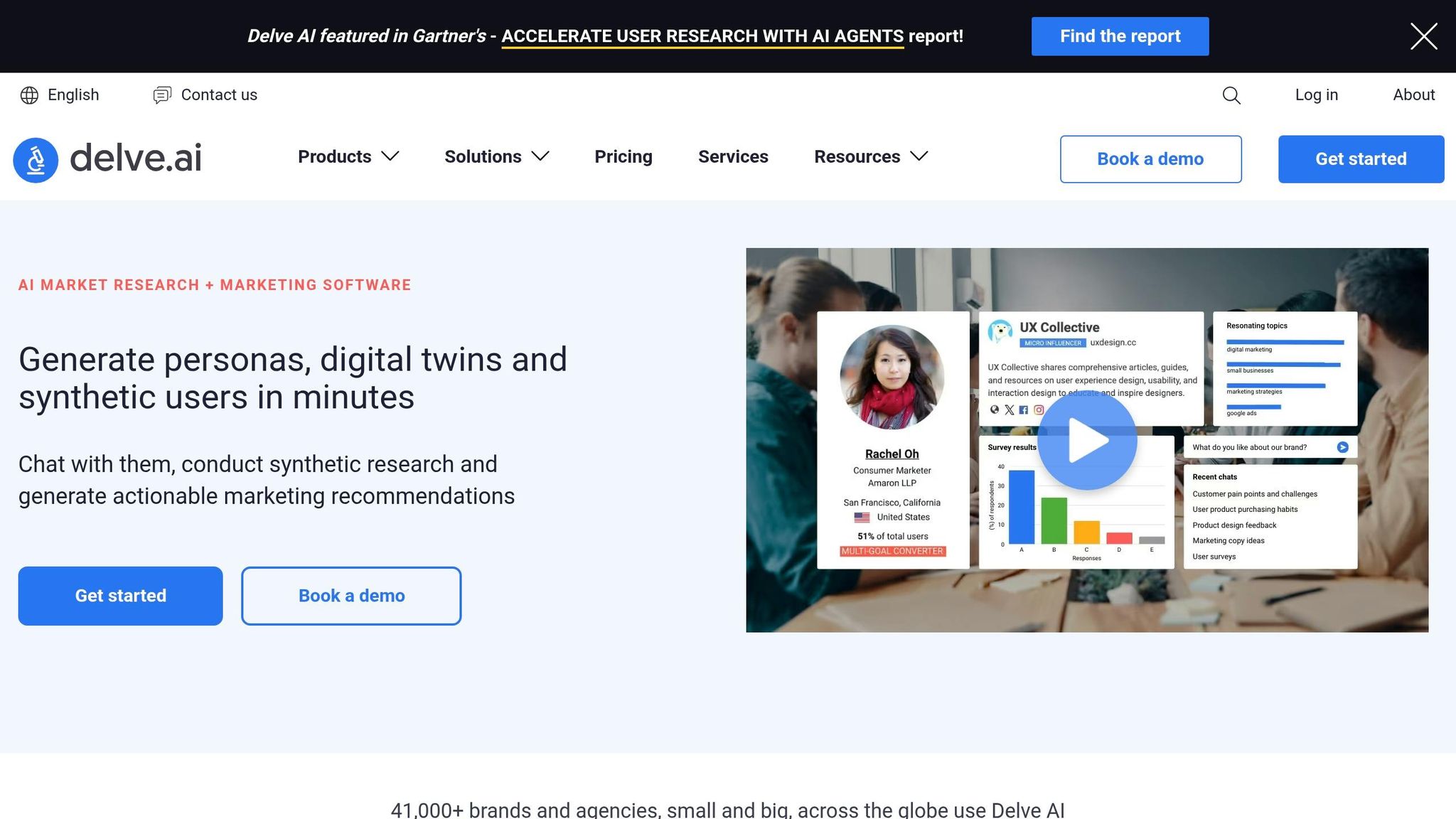
Delve AI focuses on creating detailed audience personas to provide deeper insights into what drives engagement. Its approach goes beyond just identifying the audience by digging into the reasons behind their behavior. The platform uses Automatic Marketing Segmentation across five key dimensions:
- Behavioral: Tracks engagement and intent.
- Psychographic: Explores lifestyles and values.
- Demographic: Covers age and gender for B2C, and industry and job roles for B2B.
- Geographic: Analyzes location-based context.
- Transactional: Looks at order histories and goal completions.
This comprehensive perspective helps media networks not just understand who their audience is but also uncover why they connect with specific content.
Segmentation Methodology
One standout feature of Delve AI is its use of Digital Twins - AI-generated personas that simulate market research interviews. Instead of spending weeks on traditional focus groups, Delve AI uses synthetic surveys to test content ideas in mere minutes. These AI personas build detailed audience profiles by factoring in decision-making phases and uncovering psychographic traits, offering insights into the motivations behind user behavior [19].
With these rich personas in place, Delve AI integrates seamlessly with various platforms to enhance its functionality.
Integration Capabilities
Delve AI connects with tools like Salesforce, HubSpot, Google Analytics (GA4), Shopify, Klaviyo, and Stripe to pull in real customer data [20]. For media networks focusing on B2B content, integrations with OrgInfo and Google Tag Manager help identify anonymous companies visiting their sites. Additionally, its Slack integration provides real-time alerts about visits and persona updates.
Over 41,000 brands rely on Delve AI for market research, with high ratings of 4.8/5 on G2 and a perfect 5.0/5 on Capterra [21]. It was also highlighted in Gartner's "Accelerate User Research with AI Agents" report [19].
Media Network Use Cases
Delve AI's segmentation and integration capabilities allow media networks to turn audience insights into actionable strategies. The platform's Marketing Advisor tool uses persona data to generate campaign recommendations tailored to specific channels [19]. Its Social Audience Insights feature pulls valuable research directly from social media data. By combining website engagement metrics with order histories, Delve AI also helps identify subscribers with high lifetime value.
"Delve AI's technology and approach to persona based marketing is the missing link for retailers. I have seen it in action and seen the results that come from Delve AI." – Kelly Slessor, The Ecommerce Tribe [21]
5. Locatium
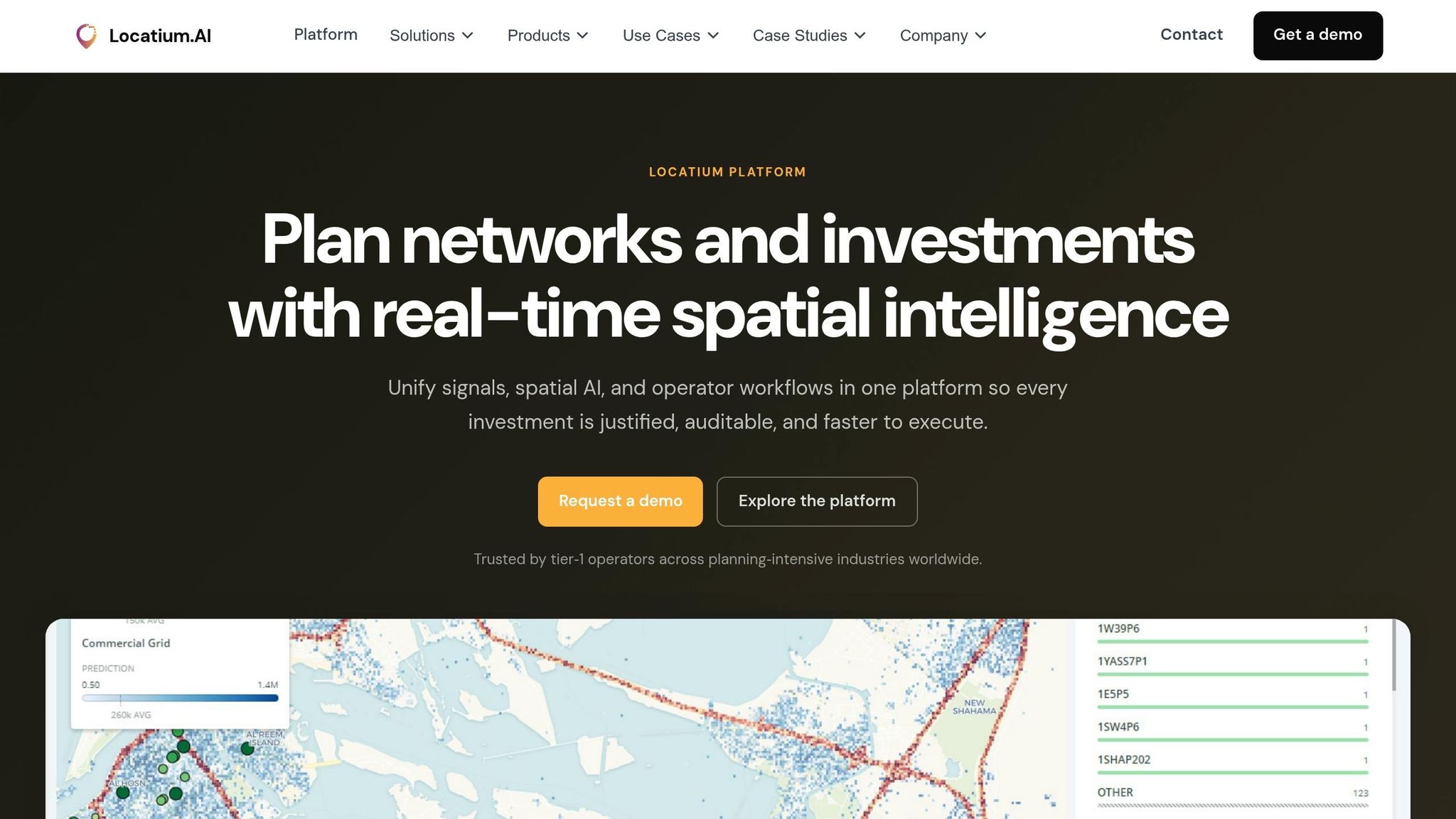
Locatium takes a different approach to audience targeting by using mobility signals from telecom data. Instead of relying on generalized demographic profiles, it taps into real-time location intelligence to pinpoint high-value audience segments. This means reaching the right people, in the right place, exactly when it matters most [22].
Segmentation Methodology
At the core of Locatium's capabilities is its AI Commercial Planning tool, which transforms raw location data into actionable business insights. This tool can analyze competitor pricing, refine territory boundaries, and identify profitable retail locations. It relies on exclusive operator data that most third-party providers can't access, enabling it to uncover customer segments that traditional methods often overlook. Impressively, Locatium can identify these high-value segments in just three days and create a tailored digital media segmentation strategy within 48 hours [22].
"Without accurate audience segmentation, digital advertising and media buys are often based on broad demographics, resulting in wasted spend and missed opportunities." – Locatium [22]
Integration Capabilities
Designed with tier-1 operators in regions like APAC, LATAM, MEA, and Europe in mind, Locatium offers a streamlined experience. The platform doesn’t require an initial data upload, allowing media networks to start segmentation right away using their current market boundaries. It integrates pricing, geo-marketing, and territory management tools into one seamless system [22].
Accuracy and Performance Metrics
Locatium delivers significant improvements in both speed and outcomes. It segments audiences 2.2 times faster than traditional methods, cuts data processing time by 85%, and boosts ad revenue by 30%. A global case study highlighted a 5 percentage point revenue increase within just 12 weeks. This level of speed and precision allows for real-time campaign adjustments [22].
Media Network Use Cases
Media networks benefit from Locatium's geo-marketing intelligence by aligning their digital ad buys with actual foot traffic patterns. By identifying high-intent locations and valuable retail sites, marketing teams can adjust spending dynamically as market conditions shift. Locatium supports applications like mass personalization, optimizing territories, and tracking market share, empowering digital marketing and media planning teams to maximize their impact [22].
Pros and Cons
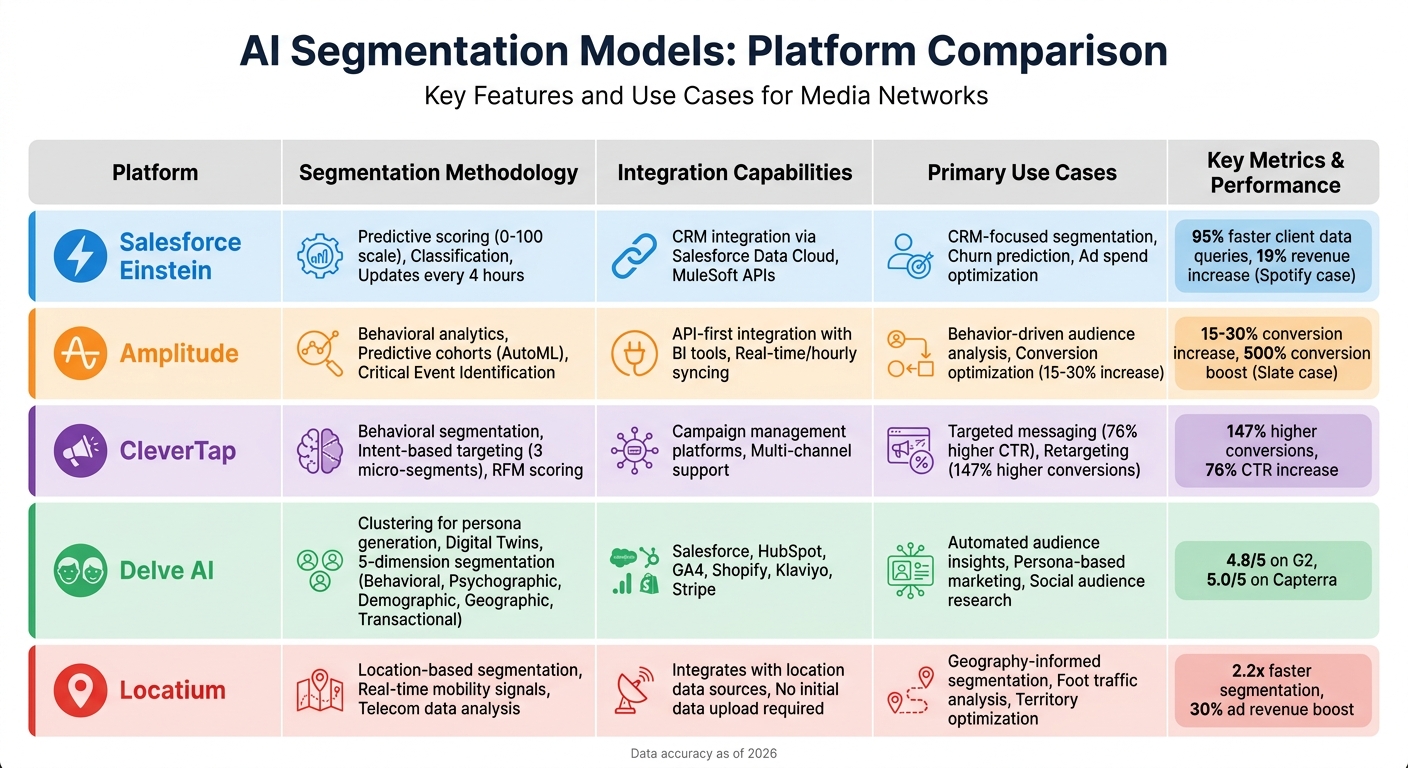
Comparison of 5 Leading AI Segmentation Platforms for Media Networks
AI segmentation models typically rely on three main techniques - clustering, classification, and predictive scoring - to address audience targeting challenges in media networks [14][23]. Each model brings its own strengths and limitations, influenced by the methodology it employs and the context in which it's applied. These differences can significantly impact integration and suitability for various use cases.
Here’s a closer look at some of the key platforms and their approaches:
- Salesforce Einstein: This model uses predictive scoring and classification, making it particularly effective for CRM workflows.
- Amplitude: Focused on behavioral analytics, Amplitude is built with an API-first approach, enabling seamless integration with business intelligence tools. Its adaptability makes it ideal for responding to shifting audience behaviors.
- Clevertap: Designed for behavioral segmentation, Clevertap excels in targeted messaging and campaign management, especially in multi-channel environments.
- Delve AI: Using clustering methods, Delve AI identifies hidden audience patterns and automates persona generation [14][23]. However, as is common with clustering techniques, its outputs may require manual validation.
- Locatium: This platform emphasizes location-based segmentation, leveraging geographic data to inform campaigns. While highly effective for location-specific strategies, it may be less suitable for campaigns targeting purely digital audiences.
Summary of Comparisons
| Model | Segmentation Methodology | Integration Capabilities | Primary Use Cases |
|---|---|---|---|
| Salesforce Einstein | Predictive scoring, classification | CRM integration | CRM-focused segmentation |
| Amplitude | Behavioral analytics | API-first integration with BI tools | Behavior-driven audience analysis |
| Clevertap | Behavioral segmentation | Supports campaign management | Targeted messaging and engagement |
| Delve AI | Clustering for persona generation [14][23] | Integrates with web and external data | Automated audience insights |
| Locatium | Location-based segmentation | Integrates with location data sources | Geography-informed segmentation |
This breakdown highlights how each model customizes its methodology to enhance audience targeting, offering solutions tailored to specific needs within digital media networks.
Conclusion
When comparing options like Salesforce Einstein, Amplitude, CleverTap, Delve AI, and Locatium, media networks have a variety of AI tools and solutions to meet their specific needs. Choosing the right AI segmentation model comes down to aligning your network's unique challenges with the strengths of each platform. For networks managing massive first-party data - billions of behavioral data points from hundreds of millions of users - advanced AI models provide the scalability needed to turn raw data into actionable audience segments[24]. These solutions allow data scientists to set up new pipelines in under 30 minutes, with campaigns fully operational within 24 hours[24].
Speed and automation are game-changers here. For example, goal-based segment optimization can boost ad click-through rates by 43%[24], and AI-powered audience expansion can grow your reachable audience by as much as 300%[2]. The platforms reviewed earlier highlight how AI eliminates many manual steps, enabling faster campaign deployment and reducing delays.
As third-party cookies become a thing of the past, the ability to leverage first-party data is more critical than ever. Models that seamlessly integrate this data with prescriptive optimization capabilities are essential. Instead of relying solely on attribute-based segmentation, media networks should look for tools offering advanced features like prescriptive uplift modeling and goal-based optimization[24]. Publishers who have adopted AI-driven contextual segmentation have seen average CPMs rise by 30–40%[1], proving the efficiency and profitability of targeted advertising.
Ultimately, the key is finding the right balance between data volume, speed of deployment, and technical capabilities. This balance is crucial for transforming large, ever-changing audiences into meaningful, actionable segments. With AI adoption in marketing expected to surpass 85% by 2026[17], selecting a platform that aligns with your business goals and operational needs could be the edge your media network needs to stay ahead.
FAQs
What first-party data do I need to start AI audience segmentation?
To get started with AI-driven audience segmentation, you’ll need first-party data - the kind you collect directly from your audience. This includes things like behavioral signals, purchase intent, search trends, social activity, and campaign performance. These data points allow AI to create audience profiles that respect privacy while enhancing targeting precision.
Make it a priority to gather proprietary data, such as how users interact with your site or what they search for. This data forms the foundation for predictive modeling and dynamic audience grouping, helping you achieve more precise and effective segmentation.
How do I choose between behavior-, persona-, and location-based segmentation?
Choosing the right segmentation strategy - whether behavior-, persona-, or location-based - comes down to your marketing goals and the audience you're trying to reach.
- Behavior-based segmentation focuses on actions, such as purchase history or engagement patterns, making it ideal for real-time targeting and personalized offers.
- Persona-based segmentation groups people based on demographics and interests, helping you craft messages that resonate on a personal level.
- Location-based segmentation zeroes in on geographic areas, perfect for running regional promotions or addressing local needs.
Often, a combination of these approaches works best, giving you a more rounded understanding of your audience. This can help achieve goals like driving conversions, building loyalty, or executing localized campaigns effectively.
How can AI segmentation work without third-party cookies?
AI segmentation operates effectively without third-party cookies by leveraging alternative data sources and machine learning. Rather than relying on cookies, it uses first-party data - things like user interactions, behavioral patterns, and purchase intent. Advanced algorithms process this data in real-time to build dynamic audience segments. This approach not only respects privacy regulations but also enhances campaign performance by driving better engagement and boosting conversions.